






Mixed Signals: CBC Radio and Hamilton

Canada’s national broadcaster is finally addressing a glaring inconsistency by investing in a radio station in this city.
BY PAUL SHAKER AND SONJA MACDONALD
City building involves many things, from physical infrastructure like streets, buildings, and watermains, to policy choices on how we decide to grow or how we can tackle homelessness and affordability. It also extends to the ways in which we can have community dialogue and how we are informed about the issues, choices, events, and opportunities around us. This is where local media comes into play.
One key part of the local media landscape is the national public broadcaster, CBC/Radio Canada. Every day, millions of Canadians across the country listen to their local CBC radio station, where they hear community news from city streets to city hall. People hear the voices of residents, business owners, and politicians talking about their city. They hear about local events from festivals to the music scene and theatre, as well as local sports teams. This happens in every city across Canada that has a local CBC radio station.
Starting later this year, this will happen in Hamilton. In March, CBC announced an expansion of local news service in Hamilton, in the form of a live audio morning show and a weekly podcast. The weekday morning show will feature community interviews, news reports, local traffic, and weather updates. It will be available on HD radio receivers (99.1-2), the CBC News app, the CBC Listen app and on the CBC website. This announcement was a long time coming.
Hamilton context
Before diving into the issue, let’s fill in some context. The Hamilton census metropolitan area (CMA), which includes Burlington and Grimsby, is home to 827,679 people, the third-largest CMA in Ontario after Toronto and Ottawa. The population is roughly on par with Winnipeg and Quebec City. Hamilton is a mature city with a rich history and a unique take on current opportunities and challenges facing mid-sized cities across Canada.
While Hamilton is part of the Greater Toronto and Hamilton Area, it’s important to note that 70 per cent of Hamiltonians live and work in the Hamilton region, with only 2.7 per cent commuting to Toronto, thus Toronto-focused local news content, whether traffic or issues from its city hall have little relevance to Hamilton residents. This is why Hamilton-focused local news and information programming is so important.
Hamilton also has a very rich history of local media firsts. The Southam family’s newspaper empire began here in 1877 with The Hamilton Spectator, CKOC is the oldest continuously operating local radio station in Canada, and CHCH was a local and national leader in developing Canadian television content throughout its early years. Despite this history and like elsewhere in Canada, the city’s private local media landscape has shrunk significantly due, in large part, to successive rounds of media ownership concentration since the early 1990s. Concentration of local media meant ownership and management moved further from the local community, often resulting in significant and successive reductions in local news programming, production, and staff. It also meant editorial responsibility for local content moved further from the communities being served, with little recourse for residents and officials to advocate for better coverage.
The most recent Hamilton example of this was the abrupt closure of 900 CHML in August 2024, the city’s only local news and current affairs station. This closure came amidst a larger sell-off of local broadcasting assets by Canadian media companies across the country.

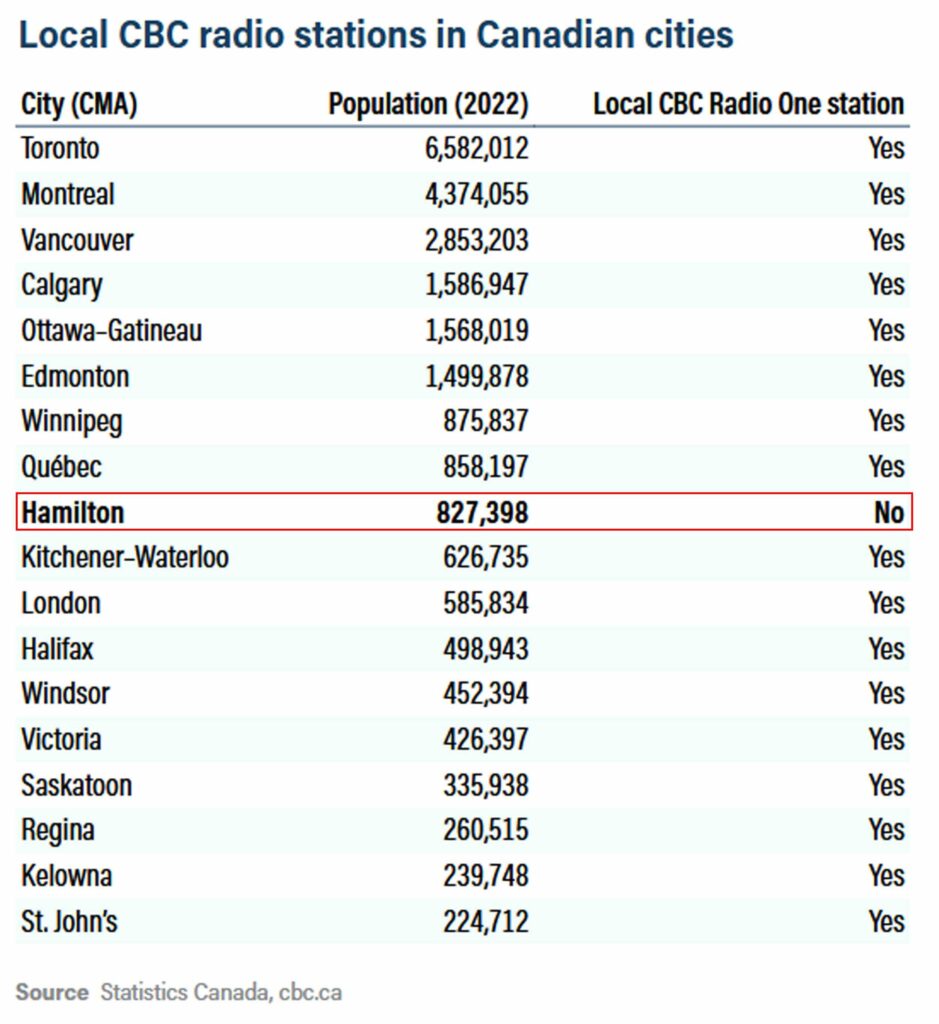
Compounding the diminishing local commercial news outlets is the fact that Hamilton has always been underserved by local CBC radio. Indeed, the Hamilton region is the largest CMA across Canada without local CBC radio service. When questioned about this, CBC has cited a lack of available radio signals as the reason. Back in 2012, after pressure from the community, CBC launched a Hamilton website, as an interim measure to provide local content, but the larger goal of a full radio station remained unaddressed. In fact, there has been a 20-year conversation between the community and the public broadcaster about this issue.
As the private media landscape was shifting over the last 20-plus years, Hamilton residents, city councils, and other political representatives have advocated for diversity in the local media environment through regulatory channels, such as at the Canadian Radio-television and Telecommunication Commission (CRTC) and directly to CBC/Radio-Canada. A grassroots CBC Radio for Hamilton campaign was launched.
Central to this advocacy was recognizing that CBC/Radio-Canada, as a public broadcaster, plays a unique role in providing local broadcasting services to cities across the country, and that this role only becomes more relevant as consolidation and divestment increases in the private sector. Further, providing service to places like Hamilton isn’t optional.
As the national public broadcaster, CBC/Radio-Canada has a broad legislative mandate, including to serve Canadians and to “reflect Canada and its regions to national and regional audiences, while serving the special needs of those regions.” The role of the CBC in local communities has long been a strong element of its success. While CBC radio is present in many cities across Canada, large and small, there are still important gaps. Hamilton is the largest example.
Why CBC Radio investment in Hamilton matters
There are several reasons why CBC’s investment in Hamilton matters, starting with the simple issue of equity. Hamiltonians contribute to the CBC through their taxes, like all other Canadians. However, where other communities of commensurate size (e.g. Quebec City or Winnipeg), and several much smaller, can rely on their local CBC stations to provide local coverage, this has not been the case in Hamilton, thus leaving one of Canada’s top regions without a reasonable and fair level of service from the public broadcaster.
Further, the amount of exposure CBC Toronto provides to its local economy translates to an exponential amount of free promotion for local business, culture, and sports, as well as having the important benefit of more coverage of local politics. Hamilton has not had access to this same exposure, despite paying for it through taxes.
Finally, local CBC radio would connect Hamilton to the national conversation. This is another major benefit, as our local stories can get more exposure across the country. Think of the coverage Hamilton got during The JUNO Awards in March. Now imagine the possibility of that more consistently, not just every few years when there is an event here.
Renewed momentum
Recently, the call for a Hamilton CBC radio station gained renewed momentum when CHML’s signal, AM 900, was given up by its former owner Corus. The CBC Radio for Hamilton campaign again called for Hamilton residents to express their views. As a result, a deluge of comments from community members was sent to the CBC to ask that they acquire AM 900 to launch a local CBC station. This included support from the mayor, as well as current and former members of Parliament. While CBC decided to pass on the frequency, only to see a Toronto station apply for the radio licence, the voices calling on the CBC to act only got louder. It looks like CBC heard the community’s message and is finally going to invest in more local programming for Hamilton.
While the goal of securing a spot for CBC on the local radio dial remains, looking to other options to increase local news and information are also important. The recent partnership between CKOC and CHCH TV whereby the CHCH Evening News is being carried live on 1150 CKOC each weekday is a good example of this. Perhaps CBC can also connect its morning show through this type of relationship with another local broadcaster, returning local Hamilton news to the radio airwaves.
Overall, this is great news for the community, and we look forward to CBC’s new Hamilton programming becoming a success and central to our city’s dialogue.
Paul Shaker and Sonja Macdonald are principals with Civicplan.