








Lessons from a walkable Montreal
Hamilton should look to Canada’s centre of urban innovation for inspiration in pedestrianizing busy streets to boost local economies, linking districts, and embracing planning with creativity and courage.
Anyone who has visited Montreal lately usually returns with positive stories to share about a North American city on the leading edge of urban innovation. I had the opportunity to visit last summer and really explored the streets on foot for the first time in many years. And it’s impressive. From the downtown festival zone to the neighbourhoods further north, there is an amazing network of districts that all link together. As a visitor, it was easy to navigate and made for an interesting stay in this memorable Canadian city.
There are many things Hamilton can learn from Montreal as we tackle the variety of issues in front of us. In fact, Hamilton would be smart to look beyond our immediate neighbour down the QEW for inspiration on what this city can be, and look further to our Quebec cousins for an example of urban innovation, creativity, and vibrancy.
So what, exactly, have they done?
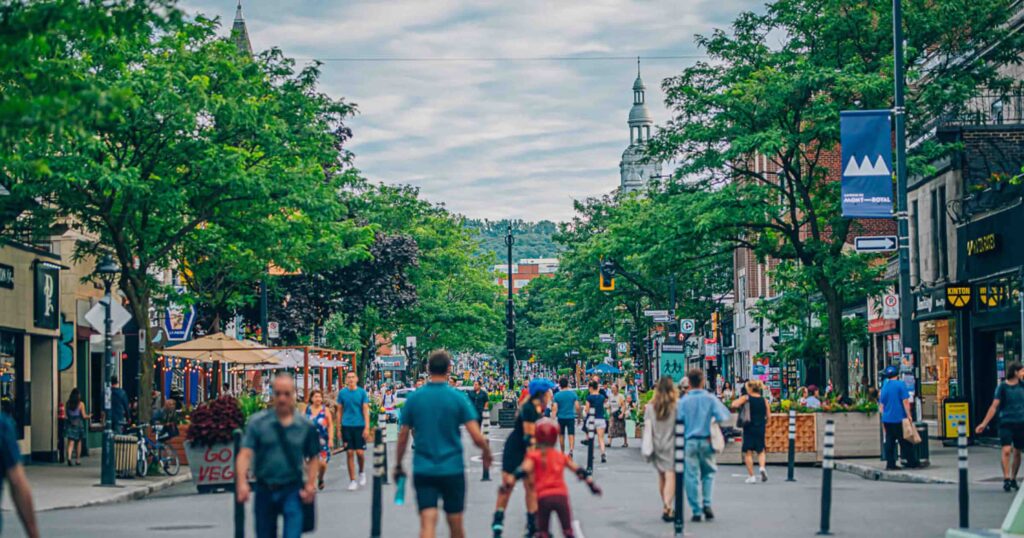
Under the leadership of its previous mayor, Montreal embarked on an ambitious plan to make the city more walkable. The plan involves the seasonal closure of some of Montreal’s busiest thoroughfares to car traffic, transforming them into pedestrianized centres, full of restaurants, markets, patios, and stores. In total, a little more than seven kilometres of roads are pedestrianized each year.
The key element that needs to be understood is that this wasn’t a transportation project – a plan to limit traffic or to get people out of their cars. It’s actually an economic development project to help boost the vibrancy of many key districts by making them destinations and linking them together. The City estimates that the pedestrianization of a select group of streets makes it easier for people to access more than 1,300 businesses.
This is done through pedestrianization and is supplemented by an impressive investment in cycling infrastructure that would put any other Canadian city to shame. Many Montrealers use bicycles to get around because there is an extensive, well-connected network of bike lanes that makes it easy. Add to this a public transit network of buses and a Metro, and residents and visitors have many options for travelling through the city.
The 15-minute city
In many ways, what Montreal has done is embrace the idea of the 15-minute city in a very practical sense. Simply put, the 15-minute city is a community development approach with the goal that everyone living in a city should have access to essential amenities within a 15-minute walk or bike ride. The term was coined by urbanist Carlos Moreno and first came to prominence in Paris where it was championed by Mayor Anne Hidalgo who made it a central part of her vision of the city’s future. Since then, the popularity of the term has spread to cities around the world.
A hallmark of the 15-minute city is having local shops and services nearby, usually in a sustainable local business district within walking distance of home. The local coffee shop, restaurants, bars, a grocery store, all contribute to quality of life. Another consideration is proximity to parks and outdoor recreational space, which are essential to healthy city living. Finally, neighbourhood schools are another important part of a 15-minute city. Elementary schools provide a focal point for daily life for thousands of families and contain recreational space that the adjacent neighbourhoods can use outside of school hours. The walk to and from school each day is a foundational activity that takes place across cities and making sure that trip is accessible and safe should be a core part of community planning.
What Hamilton can learn
Hamilton could learn many things from the experience of Montreal. The first is simply having creativity and courage when approaching city building. It’s important to emphasize that Montreal is a complex, mature city with real social and economic issues just like everywhere else, including homelessness, open drug use, crumbling infrastructure, and prosperous areas next to areas in decline. Urban-suburban tensions are in the news and on full display, playing out in the last municipal election. But they don’t stop Montreal from trying new things and innovating how they are going to develop as a city. Hamilton would be smart to take note of this. Making excuses for the current state of things, or blaming other levels of government, is not a productive use of time.
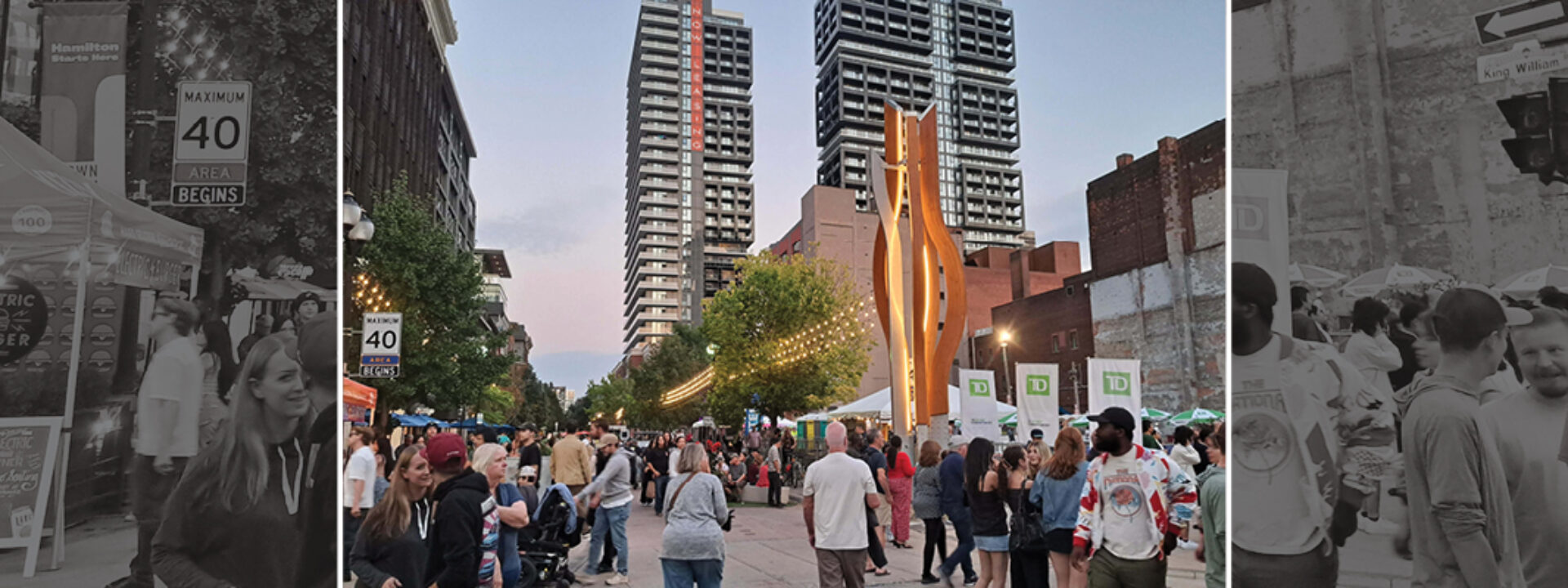
Second, Hamilton should actively find ways to connect its community districts together better. Hamilton already has some great and interesting destinations and individual BIAs do a good job of promoting themselves, but designing ways for people to easily and safely visit more than one is a next step. Pedestrianization already happens sporadically on some streets, for example, during Supercrawl on James Street North or Sundays UnLocked on Locke Street South throughout the summer.
But that doesn’t necessarily need to be the goal for all areas. The important thing is connectivity, being able to walk or cycle between districts conveniently and without concern. This can happen more readily in some areas of the city as compared to others and that points to a good place to start. Specifically, there is an obvious network of areas in Ward 1 and 2 that could be better connected. This includes Locke Street, King and Main streets, Hess Village, James Street North and South, Gore Park, and the International Village. The longer distances between these areas (e.g. Locke Street South to James Street North) are roughly 2 km, which is comparable to the central network of districts in Montreal located between Saint-Catherine Street in the downtown and Mount-Royal Avenue to the north.
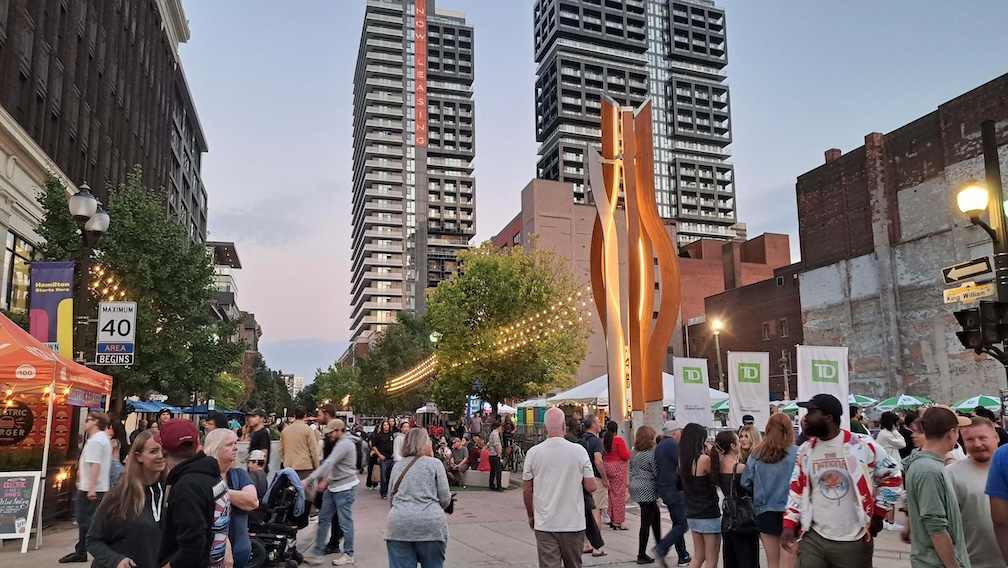
However, distance is only one factor. The experience of travelling between districts needs to be considered. This means attention to things like how friendly and comfortable the streets are for walking. This is where pedestrianization is a huge plus as it’s the ideal walkable environment. If that’s not an option, other things need to be considered, like street design. How wide are the sidewalks? What are the speed limits? (It’s worth noting that many of Montreal’s streets are now 30 km/h).
As an example, imagine walking from the Locke South business district to downtown. Even though Main Street West would be a quicker trip, a route through adjacent neighbourhoods that avoids Main Street West is often taken because of how inhospitable Main Street is to pedestrians. Unfortunately, that leaves businesses on Main Street West without all the foot traffic they would get if it was a properly designed urban environment. By comparison, in Montreal, a stretch of road like Main Street West would be bustling with people, cyclists, and patios. Main West is scheduled to be redesigned in the coming years. Here’s hoping that they fix what is a broken design that impacts everyone, residents and businesses alike.
Frequent, accessible transit is another way to connect areas that are further apart. Hamilton has a Waterfront Shuttle that provides a free ride from downtown to the waterfront during the summer months. Perhaps this route could be redesigned to provide connections between many of the central city BIAs as well, creating easy, reliable transportation delivering customers to the front doors of small businesses.
None of these investments are charity. They are the building blocks of economic development. We wouldn’t think of building a business park and then not investing the tens of millions of dollars to connect it with proper infrastructure. Making areas of Hamilton more connected is no different. In fact, it’s literally how the city was designed to begin with. Montreal is rediscovering this with great success. It’s time Hamilton does the same.
Paul Shaker is a Hamilton-based urban planner and principal with Civicplan.