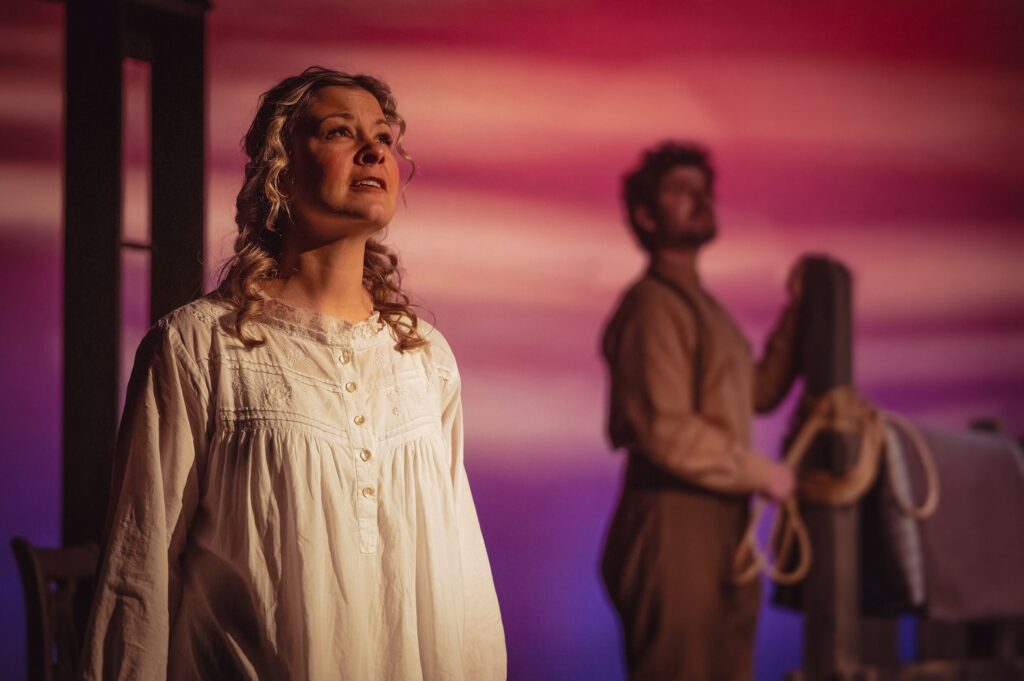









REVIEW: Mary’s Wedding is transcendent theatre that is not to be missed
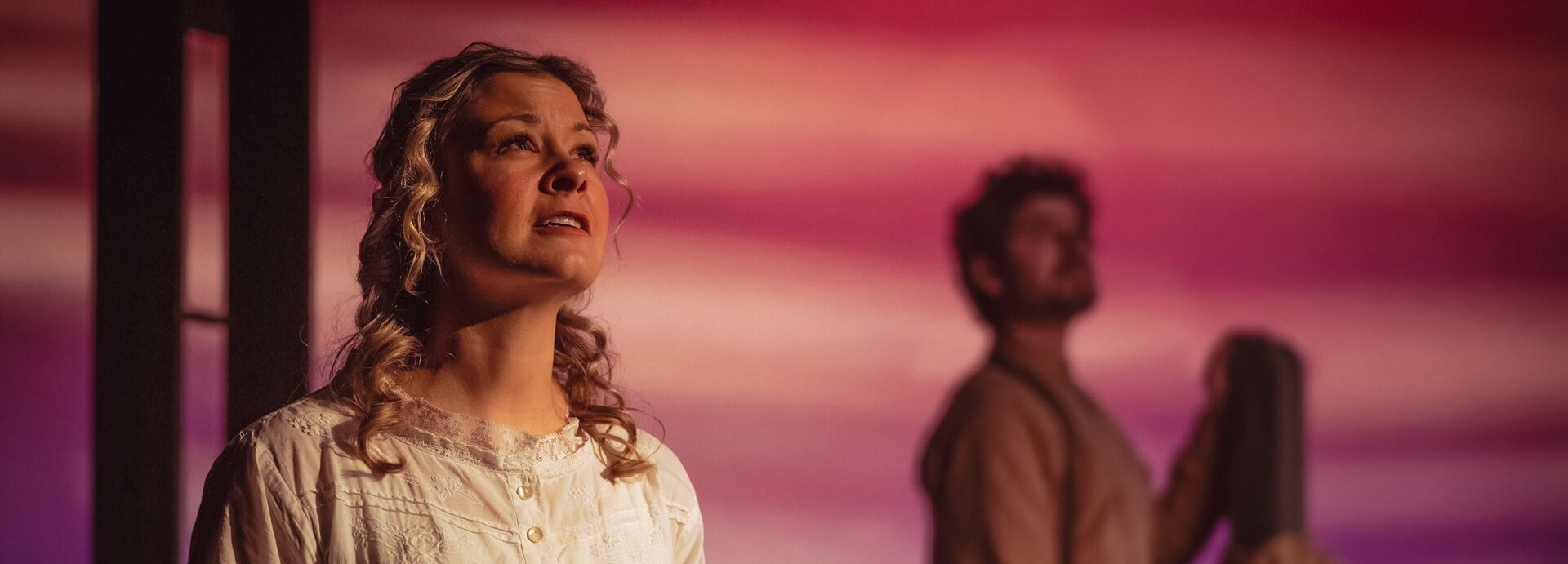
This Theatre Burlington production, a love story set in World War I, is beautifully written, acted, and staged, evoking deep emotion and profound hope.
A sweet and burgeoning love is placed on a collision course with the events of World War I in Theatre Burlington’s newest production Mary’s Wedding. The hopes and dreams of so many, particularly the young adults of that era, turned into a nightmare of blood, ash and mud in the wake of the brutal conflict. Mary’s Wedding plays out in the form of a non-linear dream that tells a rich, emotional story of youth, love, loss, and finding the ability to live again. Actors Claire Sears and Brandon James Sim turn in breathtaking performances that leave audience members by turns holding their breath and dabbing their eyes. It is a beautifully staged, transcendent production that should not be missed.
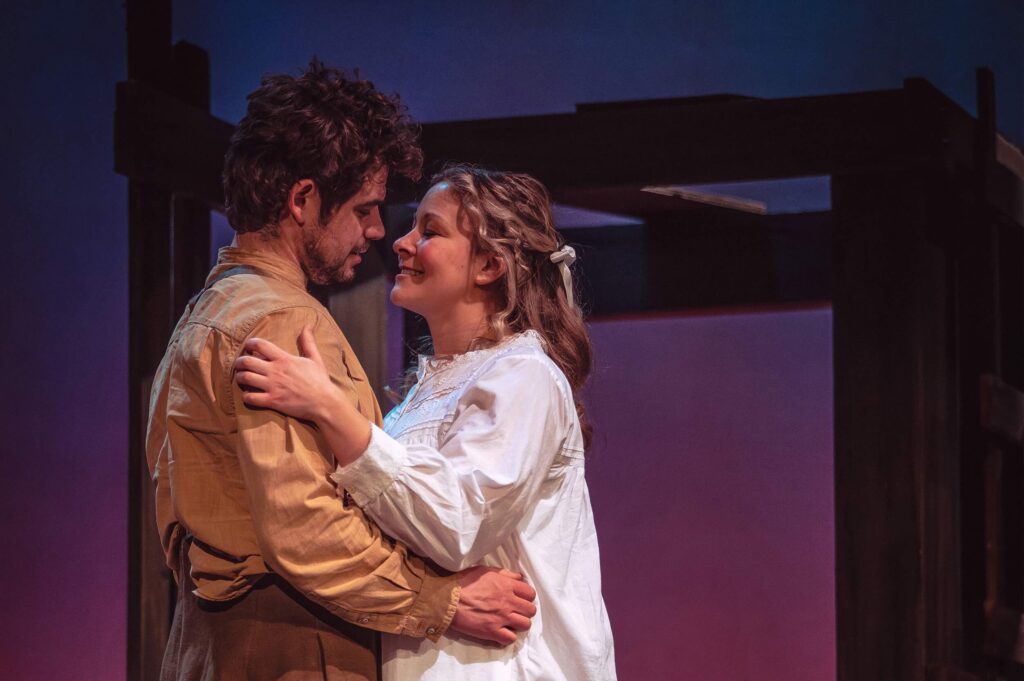
It’s 1920. The night before her wedding, Mary dreams of Charlie and his horse standing in a field amidst a lashing thunderstorm. He calls out to her, but she can’t make out what he has said. Then we’re transported to the day she first met Charlie when they shelter in a barn during another prairie thunderstorm, years before. He gives her a ride home on his horse, and they shyly, sweetly begin to fall in love. Mary’s mother, whom we never see, doesn’t think Charlie, a farmer’s son, is good enough for her daughter but we and Mary fall more and more deeply for the handsome and earnest young man. Their lives are upturned when World War I breaks out and Charlie enlists. There is a side to this that holds pride, adventure and a proving of one’s mettle for Charlie as a soldier but for those left at home, like Mary, the waiting and the unknown is punctuated only by letters and ever-more fearful news.
Six-time Theatre Burlington director Moe Dwyer has loved and shared this play with her drama students for many years, and calls the opportunity to helm this production “a dream come true.” Mary’s Wedding is written by Stephen Massicotte, a playwright, screenwriter and actor who hails from Trenton, Ont. and now lives in New York City. Born in the 1960s, Massicotte grew up in Thunder Bay and attended post-secondary in Sudbury and Calgary. His first plays were one-act Fringe productions, including The Boy's Own Jedi Handbook, a coming-of-age story. His other plays include My Life of Crime, A Farewell to Kings: A Banger Play, Looking After Eden, Pervert, The Emperor of Atlantis, The Oxford Roof Climber’s Rebellion, and The Clockmaker. Over the past two decades, Massicotte has also been a screenwriter for TV and film, including Disney TV and CBC.
Mary’s Wedding was Massicotte’s first full-length work. which makes its impact all the more astounding. It took three years to research it before the play won the Alberta Foundation of the Arts’ Playwriting Competition in 2000. It then underwent two additional years of performance, reworking and workshopping in Edmonton and Banff after which it premiered as a mainstage production at the annual Alberta Theatre Project’s playRites festival in 2002. It was awarded the Betty Mitchell Award for Outstanding New Play that year as well as the Gwen Pharis Ringwood Award.
Mary’s Wedding has been produced across the country from Ottawa to Victoria, Regina to Thunder Bay, the Eastern Townships (Quebec) to New Brunswick. It has also been staged in Washington and San Jose, in Scotland and in England. Mary’s Wedding has been translated into French and adapted both as an opera and for specifically Métis characters.
Mary’s Wedding is very reminiscent of another deeply impactful Theatre Burlington production, Bluebirds, from last spring. They share the setting of the first World War, a foreboding and expectant tone, and dream-like and evocative audio-visual elements in conjuring up the horrors of war. Both plays have moments of visceral and bittersweet emotion in their portrayals of war and its deep impacts on the lives and psyches of young Canadians. In the case of Bluebirds, it was a trio of military nurses patching up soldiers amidst the horrors of modern trench warfare. Both plays, written for 21st-century audiences, include thoughtful reflections on the effects of war and death on young adults, including the psychological and physical horrors of the use of modern war technologies, including chlorine gas and aerial bombing. Coincidentally, Stephen Massicotte’s latest play, Stars on Her Shoulders, follows five nurses based in a Canadian field hospital and explores their very different responses to their role in the war.
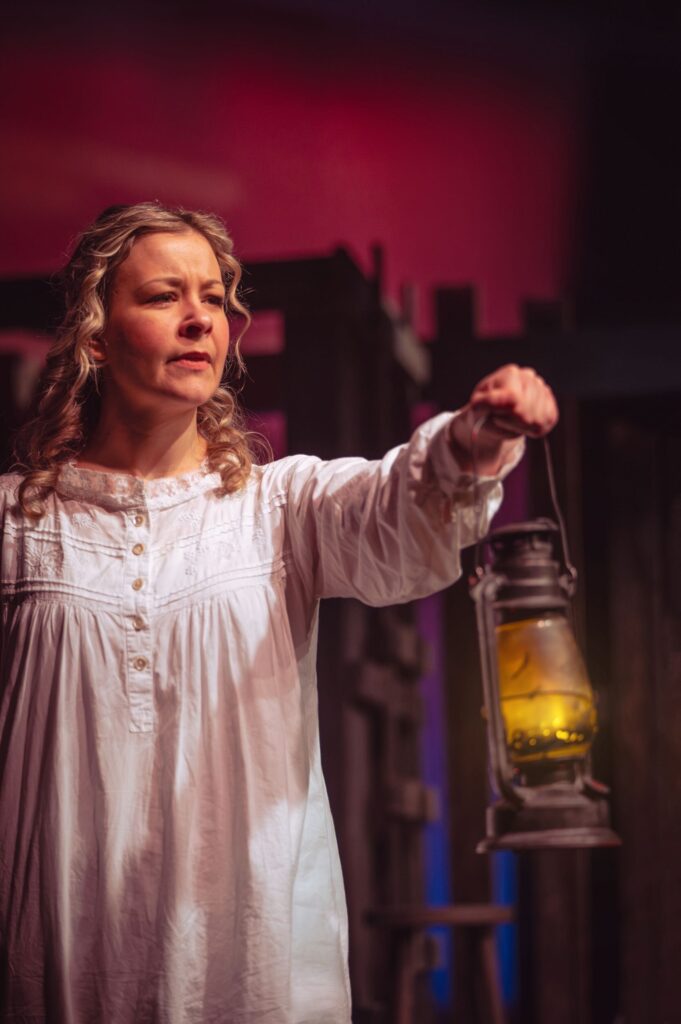
The set design at Theatre Burlington is extremely clever, evoking a rainswept field, a barn, a horseback ride, a meeting in town, a tea party and the frontlines, as Mary takes us through her memories, some springing from the letters Charlie sends her after he enlists and travels with Lord Strathcona’s Horse Regiment to England and then on to France. Through letters, Charlie tells Mary of his experiences as a soldier, including interactions with his superior officer, Sergeant (later Lieutenant) Flowerdew, also played (most remarkably) by Claire Sears. The war scenes culminate with the battle of Moreuil Wood, where Flowerdew pushes their mounted squadron past German machine guns. This is all from a set constructed mostly of planks of wood, rope, and sand bags.
Along with the set, Sim’s physicality and energy in portraying Charlie’s war experience are considerable. It’s an experience that alternates between moments when time ticks slowly and all senses are heightened with the white-knuckle chaos of riding his horse across a battlefield screaming with machine-gun fire.
As the main narrator, Sears does a particularly astonishing job in constructing a world that moves to and fro in time, portraying vignettes from the memories of several years within the dreamscape of one night. The script is extremely dense and text-heavy for Sears’ Mary (not to mention Flowerdew), and I was bowled over by her breathtaking ability to perform such exposition while taking the audience even further to transcend the sight before its eyes. It’s not enough to say that Sears and Sim move beautifully on stage and say their lines well: the play became transcendent. They had me seeing a skittish horse, a grassy meadow, a muddy, writhing, and a groaning field of battle within my mind’s eye.
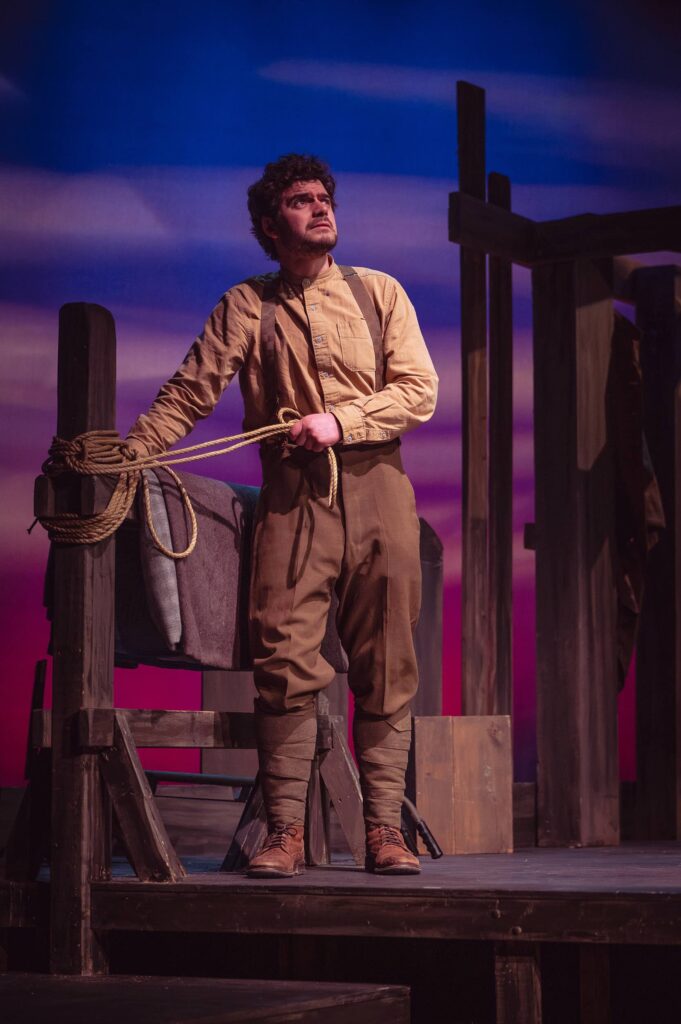
Late in the play, Charlie begs Mary not to be destroyed by grief or stay in her dreams but to live life fully as a way to honour and love him still, “just a little bit less.” In those moments, my own grief over my mother’s death spilled open and I’m not ashamed to say I cried. It took me a few minutes to compose myself. But in those moments I know for certain that the play achieved something authentic and resonant and true to life.
Congratulations to Dwyer, Sears, Sim, producers Michael Hannigan and Michelle Spanik, stage manager David Faulkner-Rundle, assistant stage manager Nancie Mleczko as well as all those involved with set design and construction, lighting design and operation, and sound design and operation on a job well done.
Despite the premise of war and the deep emotion within Mary’s Wedding, hope has the last word in this story. As director Dwyer states in the program, “Charlie will help Mary to find the light of remembrance, eternal love, and most importantly, hope.” There are moments these days when hope seems a bit of an elusive commodity. And yet, as with the Six Hundred from Tennyson’s poem The Charge of Light Brigade (featured in the play), we must endure and fight on boldly.
According to playwright Massicotte and embodied so beautifully by Mary’s Wedding, “hope is this precarious act of profound bravery.”
NEED TO KNOW
Mary’s Wedding
Continues Feb. 27 & 28, 8 p.m. and Feb. 28, 2 p.m. matinees
Theatre Burlington
2311 New Street, Burlington
Box office: 905-639-7700
Tickets
95 minutes with no intermission
Warning: use of strobe light