






Getting back on the VIA track

It’s been 18 years since VIA Rail committed to stopping again in Hamilton, something the Crown corporation hasn’t done since 1992. The West Harbour station would allow VIA to directly serve Hamiltonians, but the trains still just pass through the city. It’s time that changes.
If you find yourself in the Great Hall of Union Station in downtown Toronto, take a moment to gaze upwards. Aside from the beauty of the architecture, you’ll notice the names of Canadian cities engraved around the entire hall. Big and small, from east to west, all of Canada is immortalized in stone. These are the names of the cities that were connected by train – the rail network across the nation that built the Canada we know today. And up there, right where you would expect, is the city of Hamilton.
Now, if you were to try to go to the ticket kiosk and actually buy a VIA Rail ticket to Hamilton, you would be out of luck. Why? Because VIA Rail hasn’t stopped in Hamilton in almost 35 years. It’s not that the trains don’t still run from Toronto, around Lake Ontario to Niagara Falls. They do. Every day. They just don’t stop in Hamilton.
That’s a long way from where passenger rail service began in Hamilton in 1853 with the Great Western Railway stopping at the west harbour. Service continued over the years with VIA Rail stopping at the old CN Station, now LIUNA Station, on James Street North until 1992 when, in a cost-cutting move, VIA decided to consolidate service at the Aldershot station. So what’s happened since?
As with many things in Hamilton, there is a history to this. A history of studies, political promises, citizen activism, and ultimately, a lingering opportunity.
Let’s start with the activism. Back in 2004, after more than a decade of no service, citizens brought forward, to both local and federal officials, the idea of reconnecting VIA rail to Hamilton. While VIA representatives, many based out of the Crown corporation’s headquarters in Quebec, responded with a mixture of indifference and confusion, some local officials picked up the torch and advanced the issue.
To help bolster the local case, the City commissioned a study in 2006 to look at the issue of a VIA reconnection to Hamilton. After reviewing several factors such as demand, economic development impacts, access, infrastructure, and costs, it was recommended that the west harbour was the ideal location for VIA service. This location provided the highest station ridership potential, after factoring in impacts to nearby stations such as Aldershot and Grimsby. The plan would double the existing total annual VIA ridership for the area. The North End location was highlighted as being accessible by a variety of modes (driving, transit, walking) and it was the northern node for a planned inter-regional transit network.
The problem was, at the time, there was no station at the west harbour. The outcomes of this study were forwarded to VIA Rail but the Crown corporation had no plans, or budget, for a new station.
By 2008, there was a high-profile push to make a VIA Hamilton reconnection happen. While the new West Harbour GO Station wasn’t built yet, there was now a provincial promise to do so. With this new station infrastructure on the horizon, local leadership pressed VIA and the Crown corporation publicly committed to stop at the new station.
As the Hamilton Spectator reported at the time, “VIA says the Crown corporation’s trains will pull into the James Street North station when GO Transit builds the platform facility promised by Ontario. VIA has consistently said it will not spend any money on a James Street site, but if GO invests in a platform and supporting facilities, VIA will have trains that operate on the route stop there.”
That was 2008. It’s now 2026 and while passenger rail isn’t what it used to be in Canada, there is still a strong case to be made to reconnect VIA Rail to Hamilton.
First and foremost, it would mean more service. Specifically, two more trains stopping in Hamilton each day. One going east to Toronto and one going west to St. Catharines. This level of service may increase over time as more investment is made, but creating a stop on the VIA network is the first step. Second, VIA Rail connects Hamilton to other regions beyond Toronto, to points further east (Ottawa, Montreal) and points further west (Niagara Falls, New York). Third, as mentioned before, the VIA train routes already exist, they just don’t stop at West Harbour. It’s low-hanging fruit that doesn’t need a new budget. In fact, VIA Rail would be accessing a market it is currently under serving.
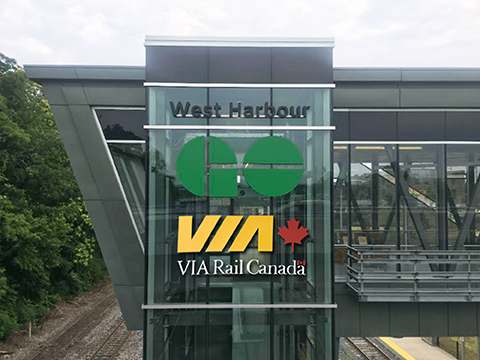
Some might think Hamilton doesn’t need VIA service, given that we already have GO trains, but consider that GO is designed to serve a different market. A Hamilton-Toronto trip on GO is the proverbial milk-run stopping at every town along the way. In total, it’s 10 stops with a trip time of about 1 hour and 20 minutes. It’s a commuter service and it shows. Now compare to VIA Rail, which would likely just have two stops, with a trip time of about 45-50 minutes. Add in the more comfortable seating compared to GO, and it’s a far more pleasant way to travel between major cities.
VIA Rail once understood this, even introducing VIA-GO ticket integration that sought to entice longer-range travellers to its service, alleviating pressure on the GO network. That potential demand hasn’t gone away. If anything, it’s even greater now as a trip on the GO train to Toronto will demonstrate.
So to summarize, we have a newish station built on the west harbour, and we have a commitment still on the books from VIA Rail to use it, and we have a case for service that makes all sorts of sense.
This idea has taken on new meaning with the recent announcement of the high-speed rail project connecting Toronto to Ottawa, Montreal, and Quebec City. Central to the success of high-speed rail, is connecting other major cities to the hubs of the high-speed rail network. In that context, a Hamilton-Toronto VIA connection should be factored into the business case of the high-speed rail project, as it would make it stronger by expanding the potential market.
With all of that, we are left with a lingering opportunity. It’s time that VIA Rail finally honoured its commitment and reconnect to Hamilton by stopping its trains at the West Harbour GO Station.
Paul Shaker is a Hamilton-based urban planner and principal with Civicplan.