




Hamilton’s short – and tempestuous – coffee culture
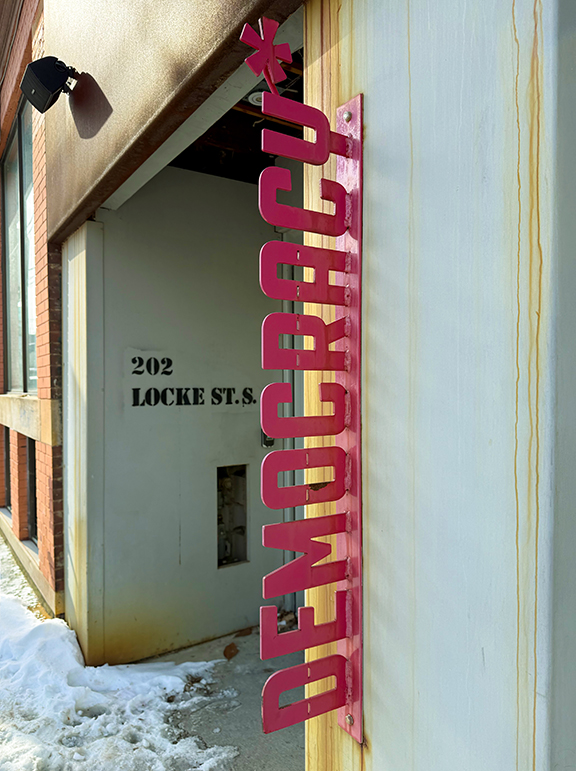
The consolidation of a small chain of shops and the sudden closure of Democracy Café on Locke Street after employees unionized, are the latest in the city’s relatively fleeting history in specialty java.
It is getting harder to find a place in Hamilton that serves a decent cup of brewed coffee, a local writer posted on Facebook a few months ago.
It’s somewhat of an exaggeration you might say, considering the number of independent specialty coffee shops in the city – most of them on major, pedestrian-friendly thoroughfares.
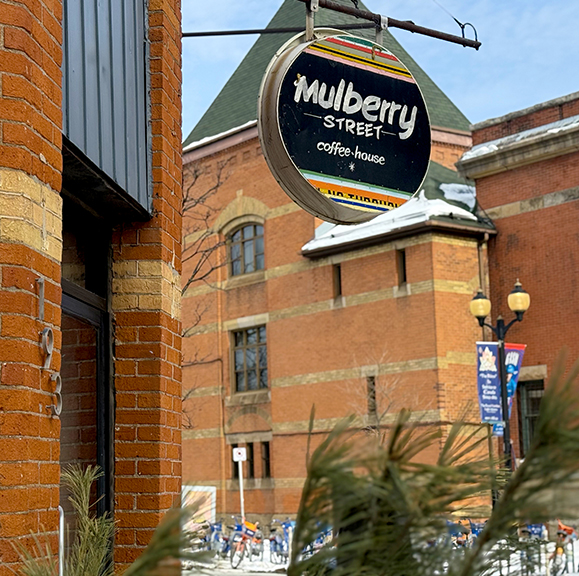
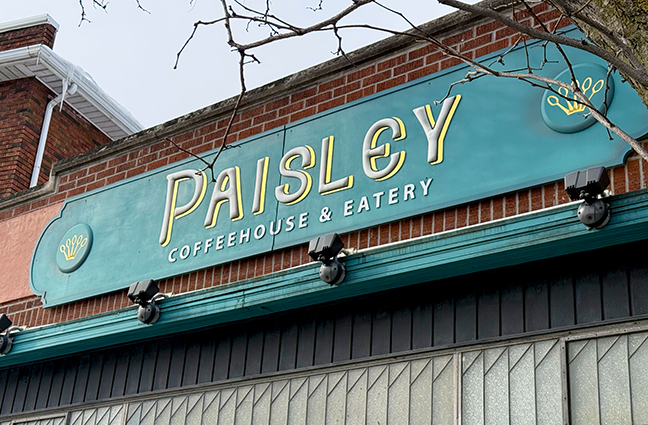
What precipitated the comment about coffee is that we are witnessing the takeover of a number of popular independent coffee shops, such as Paisley Coffeehouse & Eatery, Donut Monster, Redchurch Café + Gallery, Mulberry Coffeehouse,
and Democracy, by a single owner, Chris Mindorff, and converted into outlets in a corporate chain.
I have not heard or seen any evidence that the quality of the food and beverages have declined since he took them over and he wisely maintained the names of the former independents.
But Mindorff is not responding to media inquiries (including mine) since he closed down the popular Democracy on Locke in December after the employees voted to form a union and attempted without success to negotiate with the employer.
A GoFundMe page was set up by former employees and union allies to raise funds for staff after the owner closed the café prior to Christmas. He “opted to close the restaurant with only two weeks’ warning, and no severance offered to staff. Even within these final two weeks, management has repeatedly opted to close early, robbing staff of a chance to make money where they can, and robbing loyal customers of a chance to say goodbye to a community institution,” wrote one of the allies, Kelsea Swackhammer.
Someone who shares similar fears about finding a decent cup of coffee in Hamilton as our disappointed writer is Mina Falcone, the former owner-operator of Café Oranje, an independently owned specialty coffee shop at 314 King St. E. in the International Village neighbourhood.
Its espresso-based coffees include Americano, double espresso, café latte, caffè mocha, cappuccino, flat white, and espresso macchiato. There are also various teas and food items on the menu, including sandwiches. The previous and original owner was Dutch, explaining the reference to the House of Orange monarchy in the Netherlands. The word oranje is pronounced orania in Dutch.
Falcone recalls that Mindorff offered her advice in 2017 after she bought Café Oranje one year earlier.
“[Mindorff] was very open, very kind. I had no idea what I was doing,” Falcone says. She describes herself as a newbie in the coffee shop business; pursuing a dream after retiring from three decades of work in a McMaster University research lab.
She describes Mindorff as strictly “a money man,” who previously worked in payroll processing at Canadian Tire.
Back in 2017, Falcone says that Mindorff had part ownership in three coffee shops, Mulberry, Paisley, and Station One Coffeehouse & Eatery in Grimsby. He explained to her how he consolidated and streamlined the purchasing of coffee beans and consumables such as cups, as well as eliminated inefficiencies and avoided costs in the entire operation.
She is not opposed to any of these strategies to keep her business afloat if they are imposed with a certain degree of moderation.
The issue, she relates, is that ultimately customers come to Café Oranje because it has high-quality specialty espresso-based coffees and food made from the best ingredients from local suppliers, which can be pricey at times. There is also a neighbourly community orientation to the premises, where Falcone was there daily behind the counter with her manager, serving and talking to customers.
Plus, Café Oranje’s staff are all trained as baristas in the fine art of coffee making.
Falcone is not sure whether a corporate chain of coffee shops focused on high volumes of sales and margins can maintain the different pace and orientation of an independent specialty coffee shop.
Falcone is plainly not surprised by either what she has read about what happened at Democracy or what she has heard from a former employee who now works for her.
“It becomes the priority of the owner to become focused on making money and so they start cutting corners, and they start not treating staff as well as they should,” she says.
But Falcone concedes her strategy is a risk during a difficult economic period for all restaurants in general in Canada. Living on a pension has given her a financial cushion that makes her situation unique.
“We are surviving but it is tough. Our sales dropped about five per cent for 2024-2025, which doesn’t sound like a lot. But if you factor in that a lot of things went up [like] wages … “. (Since my interview earlier this year Falcone has retired and transferred ownership of the business of the café to her manager Cameron Logue, who is also a trained barista).
So, the question becomes: does the new chain of coffee shops represent potential decline in independent coffee outlets in Hamilton, especially when the Mulberry and Democracy emerged more than a decade ago as part of a revitalization in the city?
Hamilton was a late bloomer when it comes to specialty coffees.
The century-old and family-run, multi-generational coffee bean seller House of Java was way ahead of the curve, says its owner, Laurie Clifford at her current location on James Street South.
“The House of Java was selling specialty coffee before it was popular in Hamilton. We were doing flavoured coffee before there was flavoured coffee here. We were here before Tim Hortons and Starbucks,” she says. The store started selling espresso in the late 1990s.
Local novelist David Neil Lee, who moved to Hamilton in 2002, attributes the late arrival of good coffee in the city to a cult surrounding the once Canadian-owned and now multinational coffee and donut chain Tim Hortons among many residents. The country’s first double-double was served at 65 Ottawa St. N. in May 1964.
“I think the old Hamiltonian state of mind identifies Tim Hortons with ‘us.’ So, the bland corporation with the mass-produced coffee and donuts gets conflated with the local neighbourhood enterprise, which is Hamilton through and through,” Lee says.
A key figure in the establishment of Hamilton coffee culture is Roger Abbiss, who was responsible for the emergence of Mulberry Coffeehouse in August 2010.
Coming from Toronto and its multiplicity of coffee shops in the early 2000s, Abbiss was surprised to discover a notable absence in nearby Hamilton. Personally, he hankered for an outlet serving both good coffee and offering Wi-Fi but found this was not possible in his new surroundings.
That turned out to be a business opportunity for Abbiss.
“I had a bigger business that was in the technology area in Toronto and I was looking for a simpler life and thought a coffee shop would be that,” he says.
That materialized in 2007 with Abbiss’s opening of My Dog Joe at 1020 King St. W. in Westdale. (Today, that is the address of the Paisley coffee outlet.)
In his new career as a coffee seller, Abbiss put an emphasis on selling freshly roasted fair trade, organic, and bird-friendly coffee. He also relied at some point on a women’s co-op of coffee growers in Peru.
One of the regular customers was David Kuruc, who ran the Mixed Media arts supply store on James Street North before moving the business to Westdale years later.
Kuruc says My Dog Joe, with its “funky furniture,” was an instant hit in Westdale, responding to a pent-up demand from students, seniors, and families for an alternative sit-down venue.
“People were craving for a community. That was a big part of it. My Dog Joe was not a Tim Hortons, nor part of a chain. Instead, it was a place that was unique to its neighbourhood,” Kuruc notes.
Kuruc urged Abbiss to work a similar entrepreneurial magic on James Street North. But the owner of My Dog Joe initially turned down Kuruc’s request, contending there was not enough foot traffic to support a new local coffee shop on this strip.
Today, Kuruc recalls the counter-argument. As is often the case, artists and creative people had already taken advantage of the cheaper real estate downtown to take root along the corridor. Since 2005, James Street North has been the site of a monthly art crawl featuring local galleries on the street, that of course, morphed into the now-mammoth Supercrawl in 2009.
What was missing was a coffee shop on James Street North that was welcoming and friendly, says Kuruc. “When we were down there in 2005, to get a coffee on James Street North the only place was Café Michelangelo, which was a hangout for older Italian and Portuguese guys.”
The downtown Italian and Portuguese cafés tended to be “old school” regarding coffee. “They didn’t understand freshly roasted coffee or care about quality espresso,” says Jason Hofing, today the
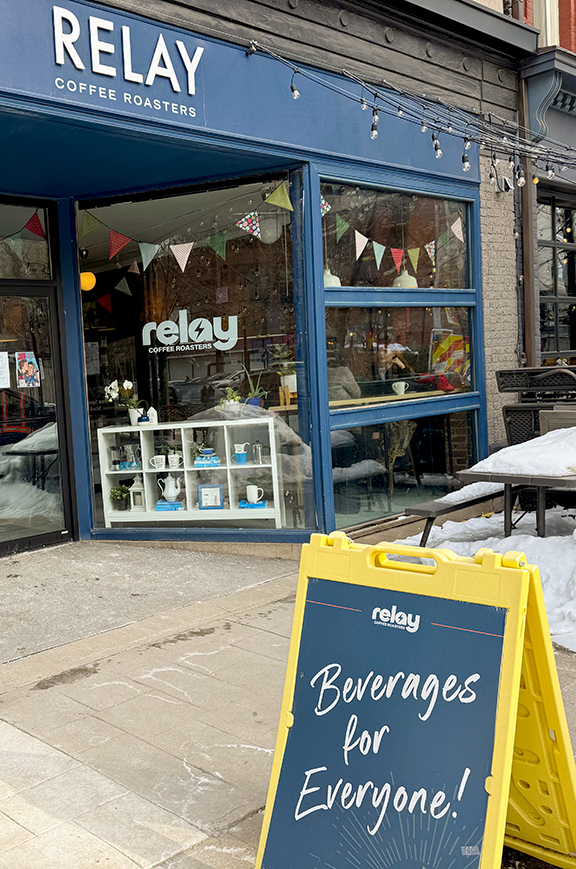
co-owner of Relay Coffee Roasters.
Hofing recalls fondly as a young person in his pre-Relay days coming down to James Street North before the Mulberry finally opened.
He was busy selling specialized coffee at local events such as a craft market and art crawl. “People didn’t know coffee in Hamilton. When we started it was, how do I present coffee to people that makes it interesting? We can talk about roasting or coffee from different countries.”
At the time, there were a few signs that downtown Hamilton was starting to emerge from the doldrums that had taken hold since about the late 1970s.
As early as 2006, the short-lived Bread and Roses coffee shop with its own roaster opened up on the ground floor of the Sky Dragon Co-operative building on King William Street, which functioned as an arts and community hub. The coffee outlet was subsequently replaced by the lively Homegrown Hamilton, which served fair-trade coffee and featured open mic music. But the place also did not last.
Lee, who is both a player and scholar of jazz, and the author of a sci-fi horror trilogy, has his own memories about Homegrown.
“Hamilton Homegrown on King William is the first indie coffee place I remember going to, and of course, it’s where Nate and Meghan go to meet H.P. Lovecraft in my novel The Midnight Games, which I began around 2011,” Lee recalls.
Today, that same space in Sky Dragon is taken up by Hofing’s Relay, which has seen a surge in popularity after being featured in the sensation that is Heated Rivalry.
Abbiss’s opposition to James Street North as the location for his second coffee shop started to become untenable by 2009.
A group of local investors had bought the historic, but rundown, former Hotel Hamilton at 193 James St. N. at the corner of Mulberry Street.
The investors saw both an opportunity to earn a financial return and to play a role in the revitalization of this street, says Kuruc. Their plan was to have studios and offices upstairs and a new coffee shop on the ground floor, then being used as a laundromat.
Hofing toured the first-floor space but turned down an offer to start a coffee shop, he says, due to a lack of capital and experience. Instead, he and his wife Rachel opened the first of their Relay outlets in 2011 with a shop on the mezzanine level in the Hamilton Farmers’ Market. (They opened another coffee shop on Concession Street in 2013. Today, their sole outlet is on King William.)
Ultimately, Abbiss had the means and the expertise to jump at the opportunity to renovate the space and create what became Mulberry Coffeehouse.
At first, Abbiss contemplated also calling the new coffee shop My Dog Joe but had a change of heart one week before the official opening in August 2010. He decided that Mulberry was a more suitable name to reflect the personality of the downtown street.
Abbiss also wanted to avoid creating a franchise chain feel, where his two coffee shops looked and felt like twins.
“We wanted [Mulberry] to develop on its own in that neighbourhood. We didn’t expect the same experience that you would with a franchise. I am an anti-franchise, anti-chain store kind of guy,” Abbiss says.
He confirms that in its early days the Mulberry was more like a coffee shop with a smaller menu and a modest kitchen and art on the wall.
After renovations to become the Mulberry of today, Abbiss eventually sold this business as well as My Dog Joe. He says he prefers the creativity of building a new small business from scratch and then allowing someone else more capable to operate the place day to day.
“I co-ordinated it all [at Mulberry] but I was not interested nor very good at running it. We learned from My Dog Joe that running a coffee shop is not my forte,” he says.
As predicted by Kuruc, Mulberry did become a popular downtown gathering place for people living and working downtown, including city hall employees, politicians, local activists, lobbyists, musicians, and other artists. Other coffee shops like Redchurch have since opened up in the core of the city.
The emergence of such coffee shops are examples of what U.S. sociologist Ray Oldenburg coined the “third place.” That is where people can socially engage with each other outside of their home and workplace.
Such informal public spaces may be a coffee shop, a restaurant or a bar, but not every coffee shop, restaurant or bar is run like a third place.
Oldenburg saw the third place as playing a major role in building community and democracy, the latter drawing on the role that cafés have played historically in Europe going back centuries.
As an aside, considering Democracy’s recent history, it opened in 2013 on Locke Street as a stand-alone independent operation by Abbiss before its change of ownership. His aim was to encourage debate and discussion among customers. “We didn’t offer Wi-Fi. The idea was that people would talk to each other,” he wrote back then.
However, political debate in a coffee shop can also turn nasty, says Clifford at the House of Java. Since an argument broke out among some individuals lined up for brewed coffee in her shop, a sign on a side counter explains the shop’s policy: “While on the premises please refrain from discussing the following — politics, religion, world events..” Customers are also asked to avoid using profanity.
Over the years, Starbucks has successfully mass marketed and commercialized the third-place concept (minus the political connotations) for its vast network of coffee outlets. But a few years ago, the corporate chain was being accused of backing away from its third-place role.
Falcone suggests that Starbucks under a new CEO is returning to third-place rhetoric, but time will tell if this will be successful.
It is certain that the presence of coffee shops played a role in the renewal of neighbourhoods and streets such as James Street North, Locke Street, and Ottawa Street North, among other destination locations.
At the same time, coffee shops have a harder time thriving in sections of Hamilton where the car is the predominant form of transportation. They function better in walkable neighbourhoods where they rely on local customers just a short distance away.
“Hamilton does not have the pedestrian traffic that Toronto has with small cafés here and there,” observes Hofing.
So, the question arises at the specialty coffee shop: What takes precedence, especially as customers pay a premium for a really good cup of coffee, the community or the java?
Café Domestiique at 102 King St. W. in Dundas is an Italian-style café that specializes in espresso-blend coffee (made from different coffee beans) as well as one-shot espresso that you can also buy in a train station in Rome.
Close to cycling trails in the Dundas Valley, Café Domestiique also describes itself as Canada’s first cycling coffee shop, with paraphernalia on the wall and riders wearing tight cycling pants ordering coffee at the front counter from owner Krys Hines.
Espresso and cycling are intimately linked in Europe, explains Hines.
At the same time, domestique is a French term for “servant” that is used in cycling to describe people assisting champion racers to succeed in competitions. The name of the café also emphasizes a relationship with customers.
Hence, there is a rejection at Café Domestiique of the “third wave” (not to be confused with third place). This represents the principles of specialty coffee providers to focus on creative roasting, grinding, and brewing techniques (the three stages of coffee making) and the sustainable and ethical practices of the coffee grower in the Global South.
“I tend to shy away from coffee with too much self importance. You will never see us advertise about our coffee,” says Hines.
Over at Durand Coffee at 142 Charlton Ave. W., which opened in 2016 and currently includes both a coffee shop and a bar, co-owner Chris Redmond counters that an independent coffee shop can be both community oriented (for the Durand neighbourhood) and support the third wave simultaneously.
Redmond says so-called third-place corporate coffee chains like Starbucks borrow or copy the rhetoric of the specialty coffee shops as customers become more discerning about their coffee.
“The third-wave approach to coffee is more crucial than ever. As corporate coffee co-opts its aesthetics, it’s become harder to tell true craftsmanship from clever branding. Without third-wave principles — a focus on quality and detail — coffee risks becoming just another marketing tool, with corners cut and flavour sacrificed for profit. Third-wave values are what keep coffee culture honest,” says Redmond.
Lisa Stanton, the owner of Vintage Coffee Roasters, which opened in 2015 at 977 King St. E. in the Stipley neighbourhood, also supports the principles of sustainable craft coffee that are displayed on her coffee shop’s website.
Yet, she maintains that the term third wave has outlived its usefulness and so avoids using it. She is concerned about potential coffee snobbery where customers might feel excluded if they come into a specialty coffee shop just wanting a cup of coffee with no bells or whistles.
“In my mind, third-wave coffee is not as accessible to everyone, and it is important that our coffees are something that everyone is going to enjoy,” says Stanton, who is the second owner of the Vintage.
“Not that we don’t have good coffees from different areas and countries. I would say, we are more third place than third wave,” says Stanton.
She is also determined to stay independent.
“I am definitely still the sole owner,” she says, and she’s not sure the emergence of a new coffee shop chain in Hamilton signals a trend just yet.
“Most of the folks I know in the coffee business wouldn’t consolidate, especially after seeing the response that Chris Mindorff’s takeover has received.”