






REVIEW: Late Company is a masterfully haunting night of mourning and torment
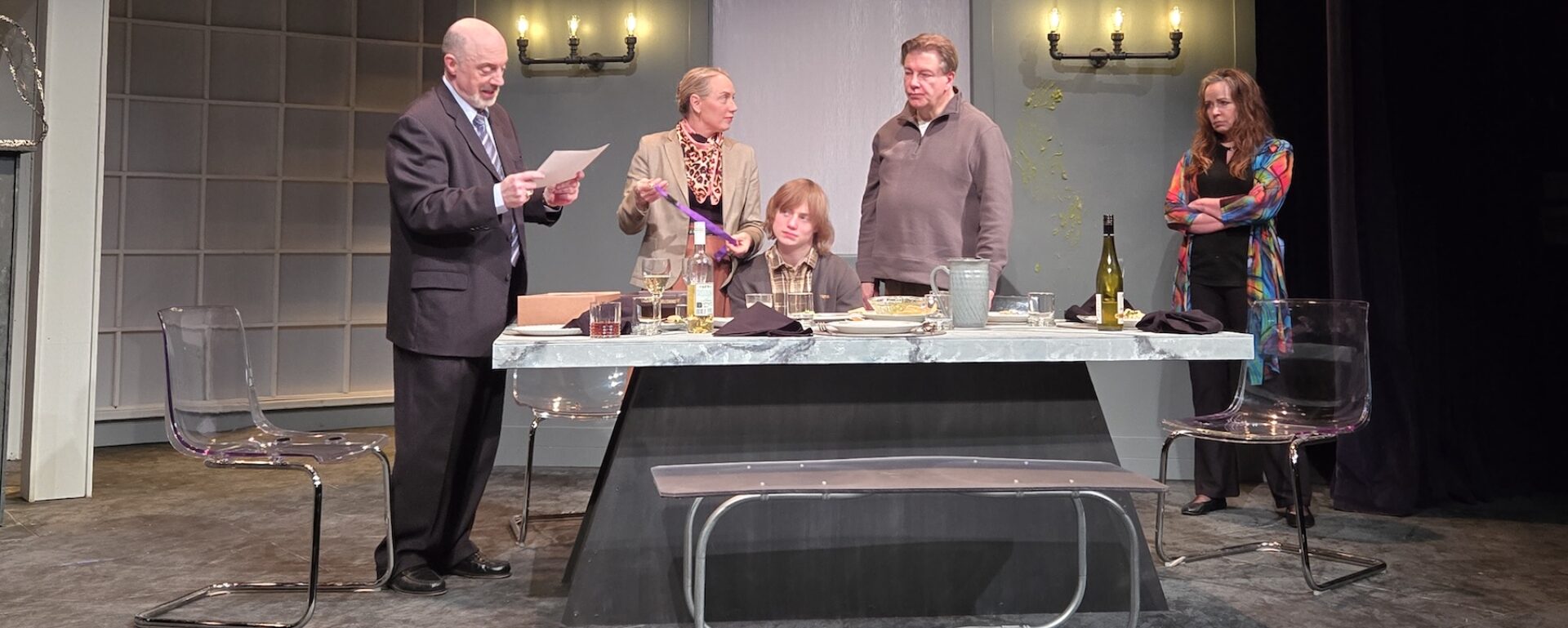
Dundas Little Theatre production tackles grief, homophobia, bullying, and parental mistakes through a relentless script, compelling acting, deft direction, and strongly atmospheric technical design.
In some plays, the most dramatic moments are those that press within the silences, hiding in-between dialogue when characters struggle to meet one another. These devastating instances make audiences sit up and take notice of the action, even as they leave a lasting impression.
Dundas Little Theatre’s stellar production of Late Company is filled with these moments and is a production not to be missed.
Written in 2013 by Canadian playwright Jordan Tannahill, Late Company is a rare piece of theatre that takes a straightforward set-up, and traps the characters inside while allowing no escape. Unfolding in real-time, Late Company pulls no punches and offers no easy answers to the questions it raises about grief, politics, bullying, and the mistakes parents make with their children.
The story opens with upscale husband and wife Deborah and Michael awaiting the arrival of another couple for dinner. We’re given few clues as to the nature of this meeting, only that there is a sacred weight to its importance. It's clear Michael would rather be anywhere else, yet Deborah is laser focused on the success of the gathering. When Tamara and Bill arrive, their teenage son Curtis in tow, uncomfortable pleasantries are exchanged, and the story veers into dangerous waters.
Only when dinner is served do the stakes become unsettlingly clear. A year ago, Deb and Michael lost their son Joel to suicide. What’s more, young Curtis was the instigator in a campaign of bullying that likely led to Joel taking his life, and the dinner is a coordinated ritual of grief and reparation for both families. Although the intentions and outward trappings are appropriate, the evening quickly spirals out of control. Long-standing resentments, and deeply buried trauma quickly bubble to the surface and explode as the night wears on. And hanging like a shadow in the silence between words, is Joel; he is a character we can only imagine but whose identity shifts depending on who speaks of him.
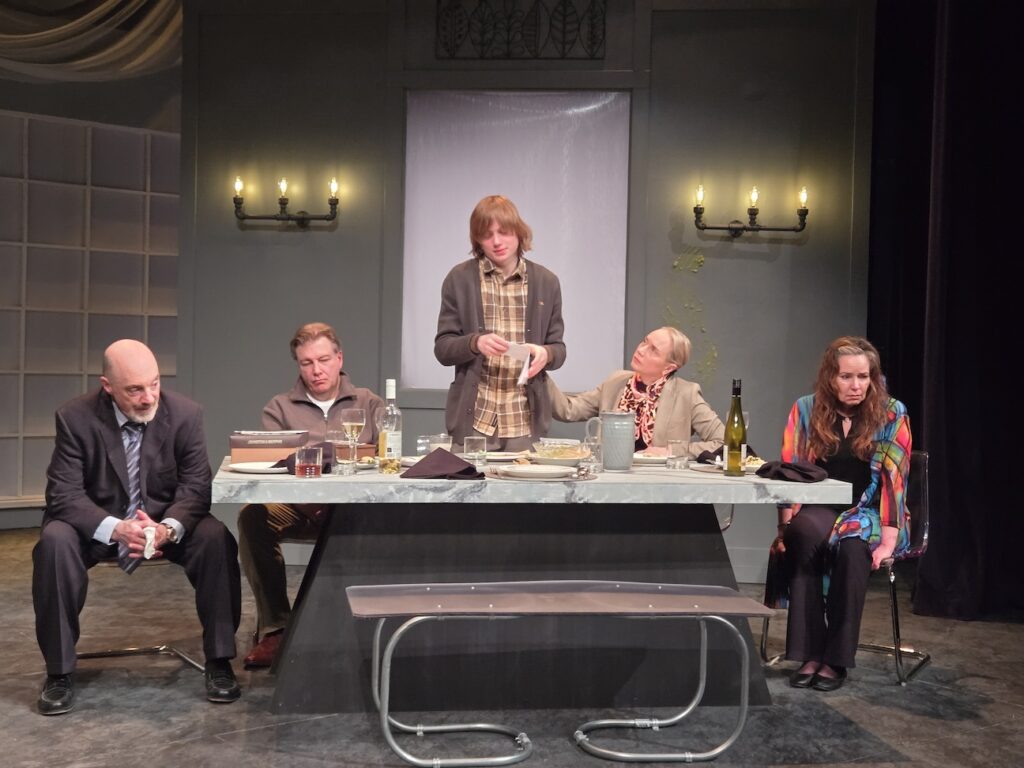
PHOTO: Jason Luckhardt
Premiering in 2013 at the Summerworks Theatre Festival, and the winner of the 2012 Enbridge playRites Award and the 2013 Herman Voaden Playwriting Competition, Late Company was loosely inspired by the 2011 suicide of Jamie Hubley, a gay teenager in Ottawa bullied in school. Hubley was the son of a prominent conservative politician, and Tannahill uses that dynamic in Late Company to draw out some of the play's more pointed moments on politics and hypocrisy.
One of Canada’s most prolific LGBTQ authors, Tannahill's writing often tackles issues around isolation and alienation, with highly theatrical language and forms. He has twice won the Governor General's Literary Award, once for Age of Minority and again for Botticelli in the Fire & Sunday in Sodom. In some ways, Tannahill's one-person play rihannaboi95 (from Age of Minority) is the spiritual prequel to Late Company. Written as an hour-long YouTube monologue, the piece chronicles the struggles and bullying faced by a queer teen after his self-made lip-sync videos go viral.
Francesca Brugnano, an experienced director and playwright, helms the production with a deft eye for keeping the characters moving. More critically, Brugnano has a great sense of pace, and she keeps the actors nimbly countering one another in a vicious ballet. Despite the weight of the play, we never linger too long on a given moment. It’s a bold choice that lets Tannahill’s script pick up the speed and momentum it needs heading into the climax. But Late Company is a drama that lives and dies on the strength of its ensemble, and Brugnano has an eye for pairing up her performers. Both couples have obvious chemistry, letting them dig into their characters’ trauma and weaponizing it against others.
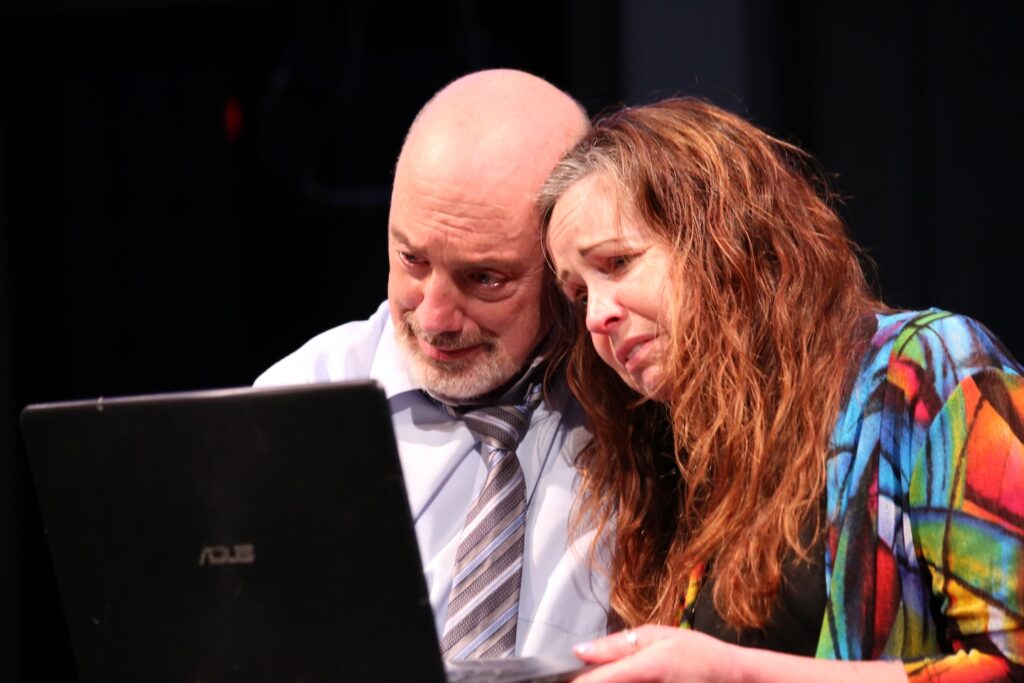
In many ways, Late Company is the story of two mothers who lose control of their children, and set to war over who is more devoted and deserving as a caregiver. They are two extremely demanding roles that never let up.
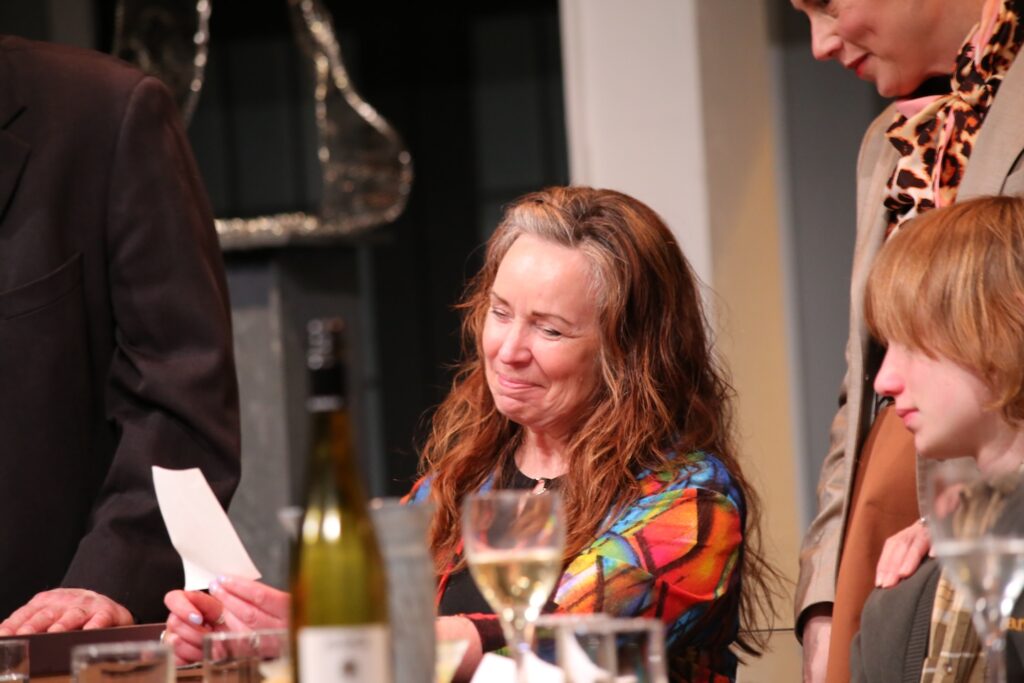
In the case of Deborah, her love has turned to a pit of grief that gives way to a barely contained visceral rage. Veteran screen performer Deanna Mae Lloyd channels Deb’s anger and pain in a performance of raw physicality that is a marvel to see. At times, Deb appears possessed by a desperate spirit that fights to articulate the full weight of her anguish. We feel empathy for her, even as we can’t help but be afraid of what she’ll do next.
Nonetheless, local performer Christine Marchetti as Tam matches wits with her beat for beat. Guarded yet generous, Tam approaches the dinner with good intentions, only to see her hopes dashed again and again. Countering Deb’s raw aggression with calculated defiance, Marchetti plays Tam as a woman worn down by years of keeping the peace. But as the ritual unfolds, and Deb’s righteous fury strips away Tam’s composure, it reveals a woman exhausted and unwilling to shoulder blame that is not hers alone. The shift, from good humour to quiet depletion, is subtle and sad, a credit to Marchetti’s talent.
The two husbands in the play are striking reflections of one another. Where Michael sidesteps confrontation, Bill firmly plants himself in nearly every encounter, and while Michael answers with evasive polish, Bill offers candid criticism on anything and everything.
Veteran stage actor James Vezina plays Michael as a practised face of manners deeply unnerved by his proximity to trauma. His barely concealed homophobia is rooted in fear, and coloured by his memories of who he thought his son should be instead of who he was. It's a study in regret and self-contempt that Vezina draws out at a marvelous and measured pace.
But the standout performance is the quiet menace of Bill played by Timothy Hevesi. Nursing a rigid moral code, Bill’s doubt for the evening’s outcome manifests in the stifled disdain he holds for Joel’s wounded parents. He is also violently judgemental, watching his son like a hawk, and keeping him in line with a sharp word or a swift hand. Hevesi gives an incredibly grounded performance, an immovable object facing increasingly unstoppable forces. By the end, we’re left with a complex portrait of a troubling man.
At the centre of the story’s firestorm, in the play’s most understated performance, is Andrew Plasky as Curtis. When he first appears, anxious and withdrawn, we’ve little idea why he has been brought by his parents. As the evening’s ritual unravels, and Curtis confesses to his feelings about Joel, an altogether different persona emerges. Is Curtis truly a bully or a casualty of his own strained upbringing? What’s most remarkable is how Curtis is perpetually haunted yet, when he speaks up, he does so with a conviction that mirrors that of his father. In a compelling turn, Plasky’s anxious nerves dissipate, showing us a young man who understands the consequences of his actions far more than he lets on.
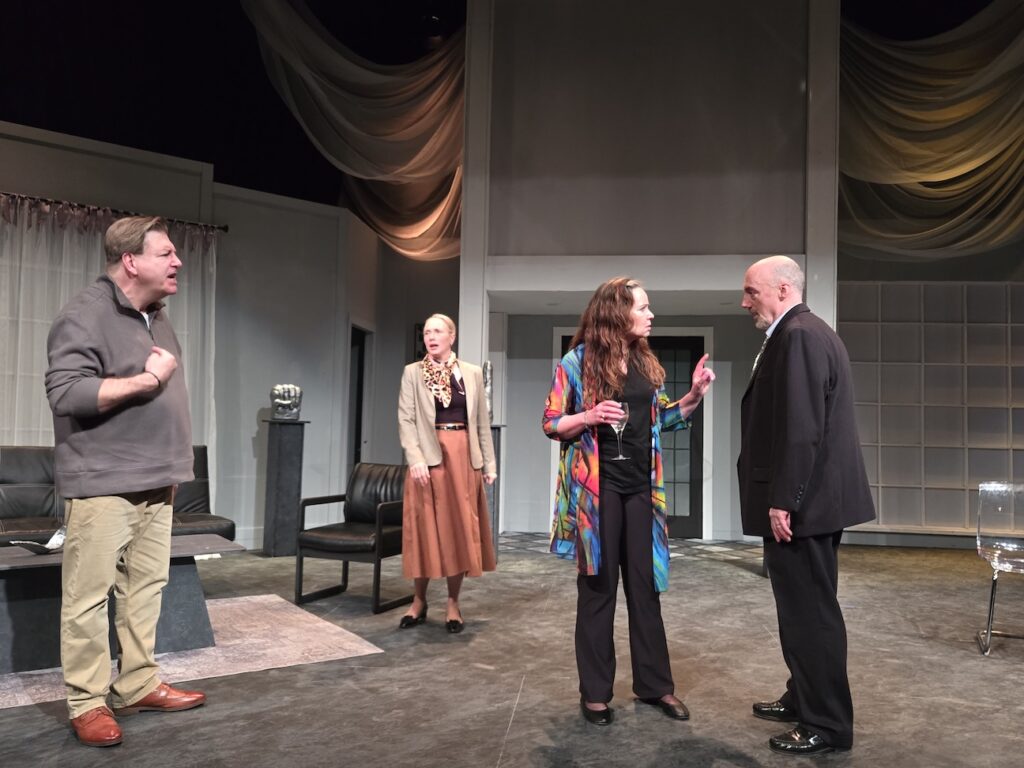
Late Company is buoyed by a technical design that accentuates the play’s stark themes and haunting mood. Set designer Graham Clements and his team have created a setting that well reflects the cool isolation of Tannahill's script. Deb and Michael's home resembles a brutalist art gallery, washed in muted colours of grey and white, with furniture that is functional and indifferent. The only flourishes come from Deb's abstract steel artwork, but even these reflect cool detachment and buried sentiment. The large DLT stage is a great canvas for this production, giving ample space for the performers to inhabit the story.
The light design by Jason Luckhardt and Alastair McIvor and sound design by Erin Garland also bring an added atmosphere to the gathering. Luckhardt and McIvor wash the stage in a shifting palette of sombre colours punctuated by bright spots that shore up the heavy points of the show. Meanwhile, Garland's sound design plays with a diegetic score, echoing Deb's musical tastes in contrast to the story’s sombre notes. But it's in the use of a haunting soundscape punctuated by incidental knockings that rattle Deb, and ratchet the tension, that Garland’s design really pays off.
However, the show’s design falters slightly in its occasional use of projections. Fundamentally, Late Company is a ghost story, and is at its most effective when the presence of Joel is implied rather than shown. When the production occasionally resorts to a projected shadow set above the main entrance, it’s a design choice that feels more overt than eerie, and sometimes threatens to draw focus away from the performers at key dramatic moments.
But this is a small crease in an otherwise skillfully executed show. Brugnano and company have done justice to a tough, compelling play, one that, sadly, remains just as relevant as it was when it was first written. Indeed, one of the hallmarks of the show is the sensitivity of the opening content notice that acknowledges the intensity of the play’s themes and reminds audiences to seek help if they are struggling.
In recent years, Dundas Little Theatre has established itself as a community theatre that embraces contemporary plays, especially those by Canadian playwrights. This year has seen the work of Tannahill, and next year will see award-winning scripts by Kate Hennig and Erin Shields. When community theatre takes big swings, and knocks the production out of the park, it’s a rare treat for audiences. Fortunately, Hamilton audiences have a chance to see such a show in DLT’s production of Late Company.
NEED TO KNOW
Late Company
Dundas Little Theatre
May 1-2-3, May 8-9-10
37 Market St. S., Dundas
905-627-1620
Tickets here