







REVIEW: Brothers Karamasov is intimate, intriguing

Young powerhouses at Cataclysm Theatre tackle Dostoevsky’s epic story of love, faith, and murder as an ambitious inaugural production with an all-female cast. It continues at The Staircase this weekend.
The final work of iconic Russian novelist Fyodor Dostevsky, The Brothers Karamasov, pulls no punches. A theological morality tale involving brothers and a corrupt elderly father, it’s an epic that’s been translated and adapted numerous times since publication in the 1880s.
Though it circles heady debates on faith, family, love, and betrayal, at the heart of The Brothers Karamasov is the schism between brothers Dmitri, Ivan, and Alyosha and their father Fyodor, alongside the servant Smerdyakov. Both arrogant and crude, Fyodor is an overbearing and abusive tyrant who seeks to control and oppress his sons. After he’s found dead, suspicion falls on Dmitri, who must face a trial, while Ivan and Alyosha struggle with questions of justice and faith, until the hidden role of Smerdyakov is revealed.
As a young company presenting its inaugural production, Cataclysm Theatre has drawn on playwright Richard Crane’s 1981 adaptation of Dostevsky’s work. Condensed into a tight 90-minute run-time, Crane’s script is minimalist in set and story, using the tenets of narrative-theatre where complex plots and multiple characters are distilled using physical storytelling and cast doubling.
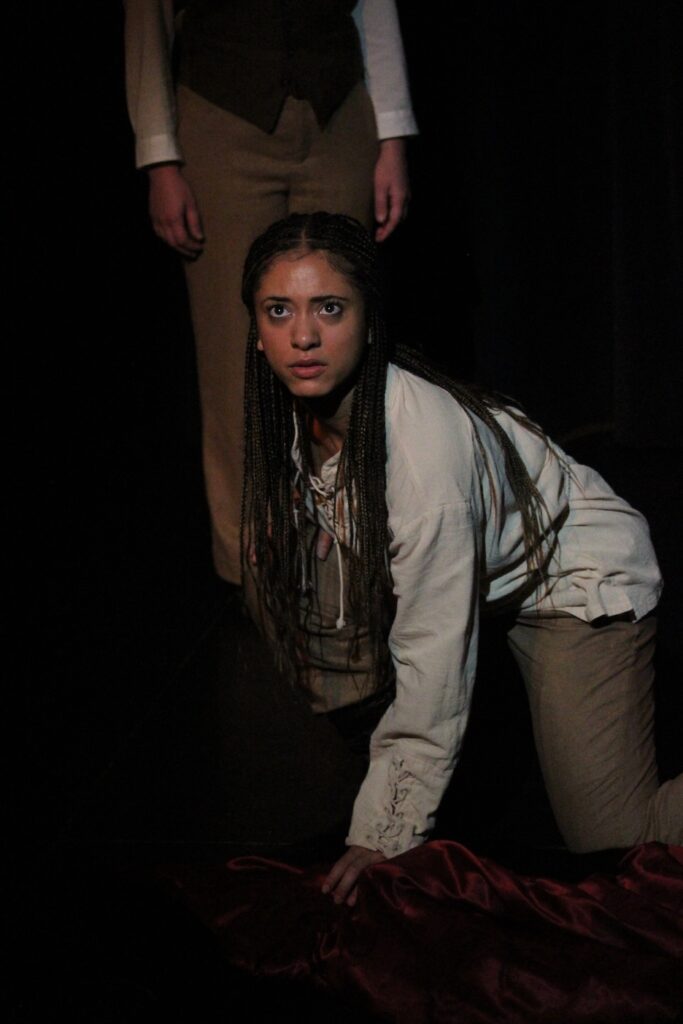
Spanning two acts, with scenes that progress organically, Brothers Karamasov often feels more like watching an epic poem rather than a traditional drama. This is especially the case given how Crane emphasizes lyrical monologues to conjure the interior worlds of its characters. These are punctuated by high-energy dialogues and transitions throughout the script using choral odes, chanting, and breathwork to create a highly stylized theatre experience.
Brothers Karamasov works largely thanks to its powerful all-female cast. An ensemble in the truest sense, all four performers bring specific strengths to Crane’s script, and collectively elevate much of Dostevsky's antiquated language into something both visceral and intimate.
Allie Waddell strikes an imposing, yet wounded, figure as the passionate Dmitry. Mercurial and militant, Dmitry’s quarrel with his father over love and money means Waddell must walk a line between defiance and despair. She does some marvelous work, specifically during Dmitry's interrogation where she literally strips away bits of clothing as his defenses whither away.
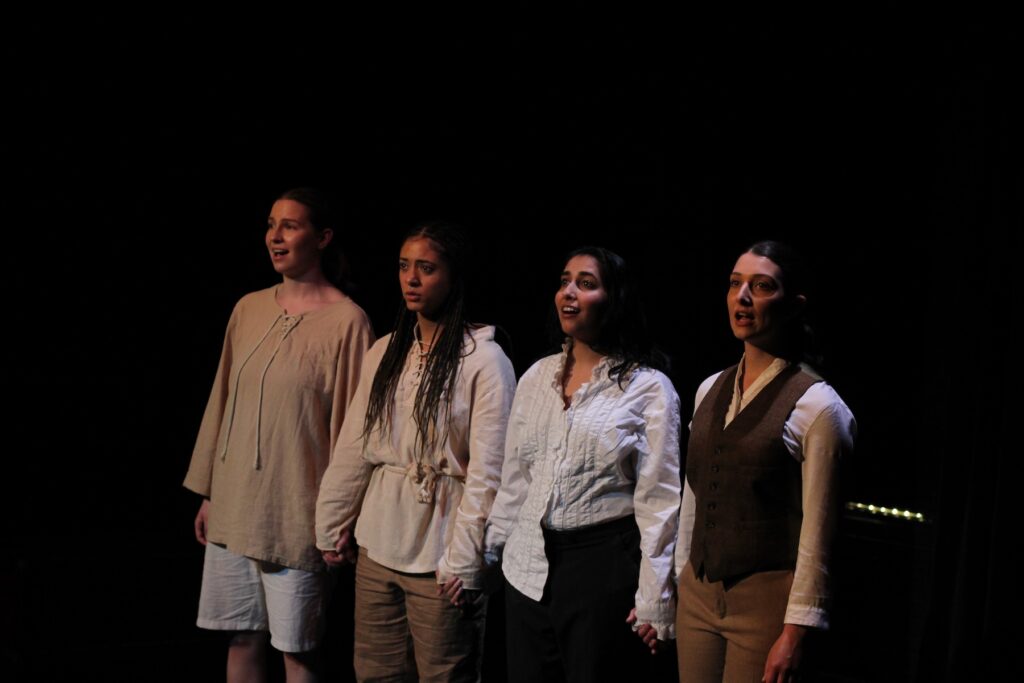
PHOTO: Sunsho Heng
As the analytical Ivan, Vandana Maharaj adopts a cool curiosity that carries her through the play's first half. But as events conspire to test his dispassion, she skillfully conveys Ivan’s unravelling logic. To her credit, Maharaj never plays Ivan as cold, merely cerebral and proud. It's a crucial distinction that makes her performance all the more intriguing.
For the humble Alyosha, Vanessa Whyte is grounded and affecting. She brings quiet conviction to Alyosha, the moral centre of the play, whose faith is continuously tested in the face of temptation and loss. Furthermore, Whyte’s harmonious voice lets her lead the show’s choral odes, while poetically isolating the innocence of her character.
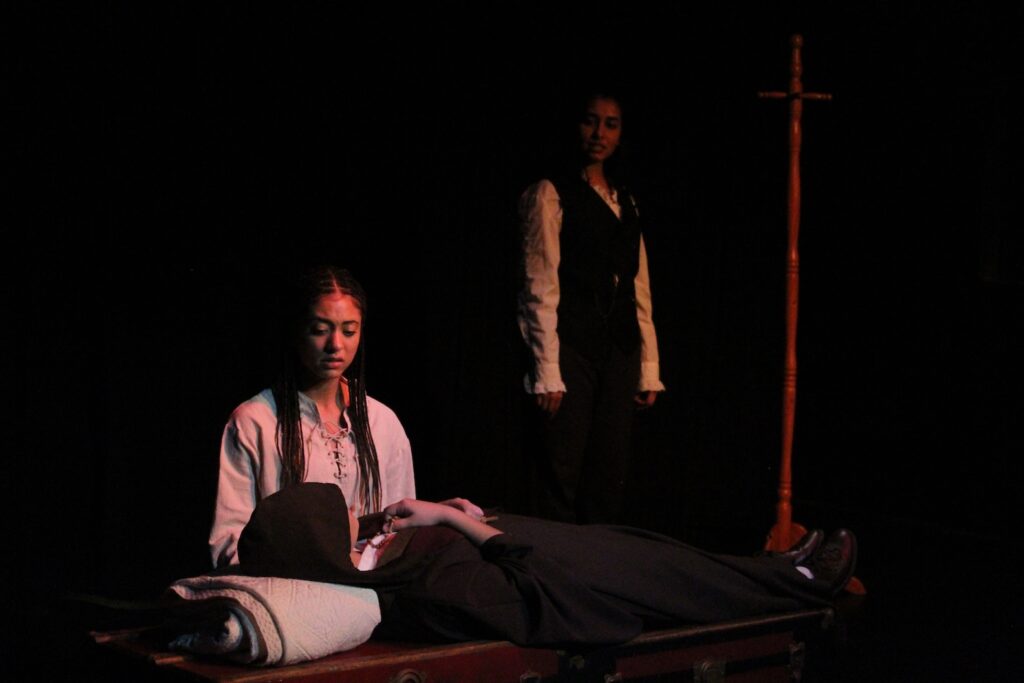
Senzenina De Freitas is riveting as Smerdyakov, playing the enigmatic servant (and Fyodor’s illegitimate son) as a precise critic who yearns for acceptance. De Freitas deftly restrains her natural charisma and exuberance, conveying Smerdyakov as the tragic, toxic figure most held hostage by the abuses of Fyodor.
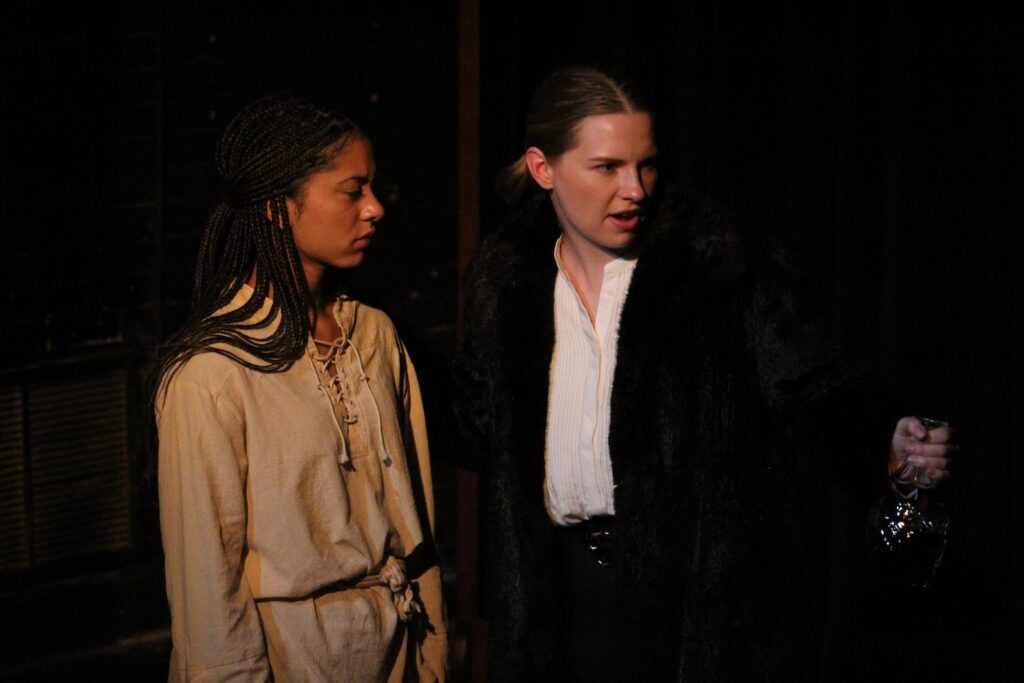
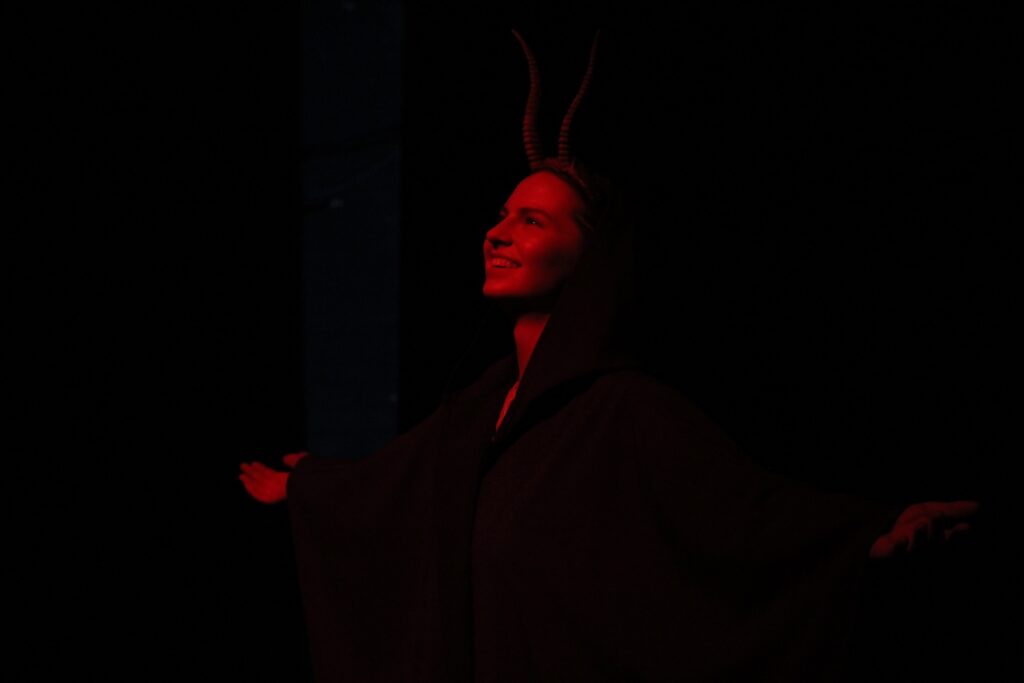
Crane's script also frequently calls upon the cast to inhabit the role of the elder Fyodor. Intriguingly, as each performer dons the signature fur coat of the character, they also embody a distinct facet of Fyodor, reflecting the physicality of their other characters. Waddell is a severe bully, while Maharaj is an evasive schemer and De Freitas is a salacious glutton.
Director David Matheson is no stranger to Crane's script, having directed another all-female production in 2012. By making use of a sparse set, specific costume pieces, and evocative lighting, he is largely able to use the confines of The Staircase to his advantage, ensuring the play smoothly flows from moment to moment, turning the sturm und drang of Dostoevsky into a passion play.
That said, the production occasionally struggles with pacing; several monologues feel protracted, while some transitions might pass too quickly for an audience to catch. More frustrating is Crane’s script, which reveals the mystery behind Fyodor’s death well before the climax, this in stark contrast to the structure of Dostevsky’s novel. Unfortunately, it drains much of the story’s suspense, forcing the play to stand on spectacle instead of stakes.
Admittedly, prior knowledge of the original story might be an asset to audiences for the simple sake of keeping track of characters and events. But Cataclysm Theatre’s Brothers Karamasov is more interested in the story’s fundamental themes and visceral impact. That it succeeds as well as it does is a remarkable feat for this company of young artists.
Cataclysm Theatre is definitely one to watch in the future.
NEED TO KNOW
Brothers Karamasov
Presented by Cataclysm Theatre
Nov. 13-14
Staircase Theatre
27 Dundurn St. N., Hamilton
Tickets, by phone: 905-746-3551 or email: booking@staircasehamilton.com