







REVIEW: Everything’s right with The Play That Goes Wrong
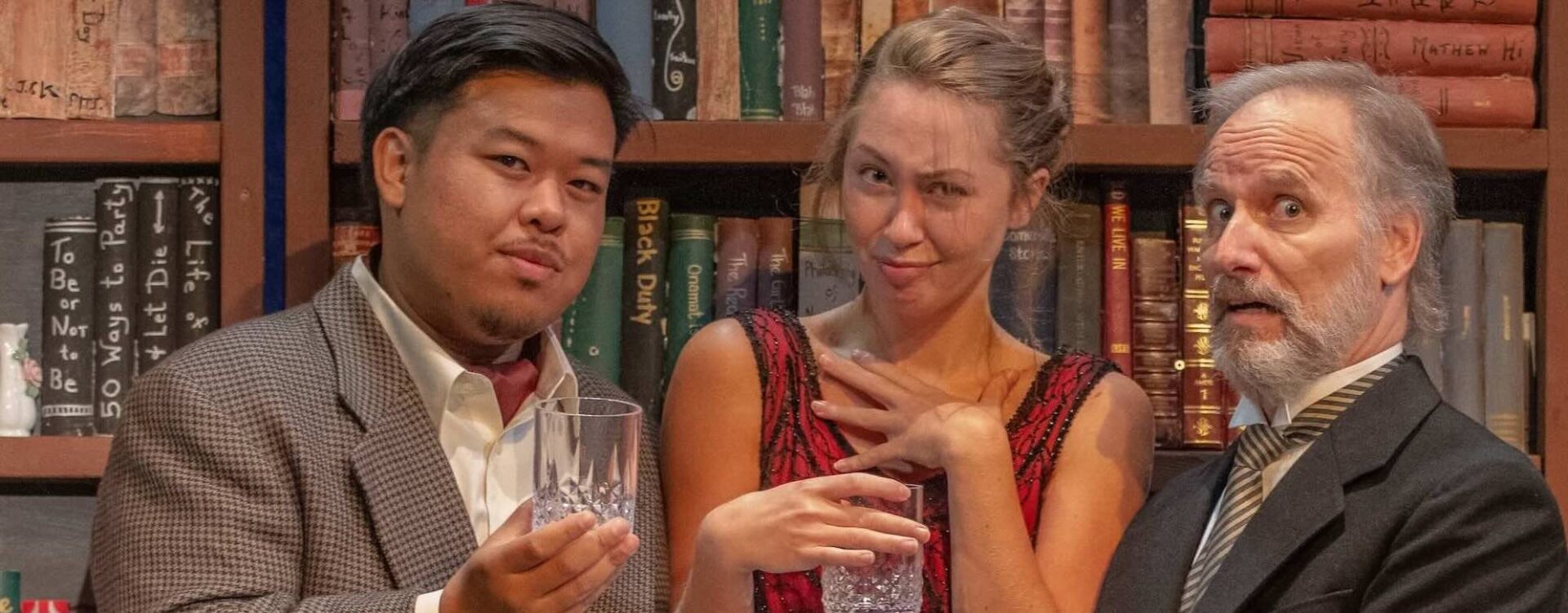
Dundas Little Theatre does a masterful job of this chaotic play-within-a-play murder mystery and its physcial comedy.
The premise of Dundas Little Theatre’s current production is stated right in the title, The Play That Goes Wrong. It’s a play-within-a-play. A small, earnest English theatre group embarks on a performance of a murder mystery called The Murder at Haversham Manor, set in 1922. The opening scene features the dead body of the manor’s resident aristocrat, Charles Haversham and so, the drama is set in motion. Imagine then that this play is subject to all the chaos that Murphy’s Law can muster. Things start to go wrong, slowly, then faster, and faster. There’s lots of laughter to be had as the desperate cast valiantly attempts to finish their performance, one way or another.
The ambitious DLT production features director and producer team Elaine Hale and Brian Morton with production management by Jason Luckhardt, assisted by Colina Phillips. It also includes technical director John Bello and stage management provided by Peter Jonasson with assistance from Alicia Nunn, Ky Moruzi, and Bella Worster. In addition to nearly a dozen cast members, the production has been built by a large production crew including particularly vital set design and construction teams, a fight director and action choreographer (Nick Oddson), a fight assistant (James R. Noble), and an intimacy coordinator (Pascal Simmons).
The Play That Goes Wrong was written by a trio of British millennial playwrights, Henry Lewis, Jonathan Sayer, and Henry Shields. It premiered in December 2012 with Mischief Theatre under the name The Murder Before Christmas at the Old Red Lion Theatre in London. It moved to Trafalgar Studios in 2013 and then the Duchess Theatre in the West End in September 2014, where it remains that venue’s longest-running play. According to publication Best in Theatre, “in September 2026, the 12th anniversary of its West End opening, Mischief announced that the Duchess Theatre booking had been extended to January 2028, taking the production into the company's own 20th anniversary year.”
The Play That Goes Wrong won the Laurence Olivier Award for Best New Play in 2015. It has subsequently had a number of U.K. tours as well as tours in the U.S. and Australia. The play opened on Broadway in 2017 at the Lyceum Theatre. The production notably featured movie director J.J. Abrams (Star Wars, Star Trek) in his debut as a theatrical producer. It closed about two years later after almost 800 performances.
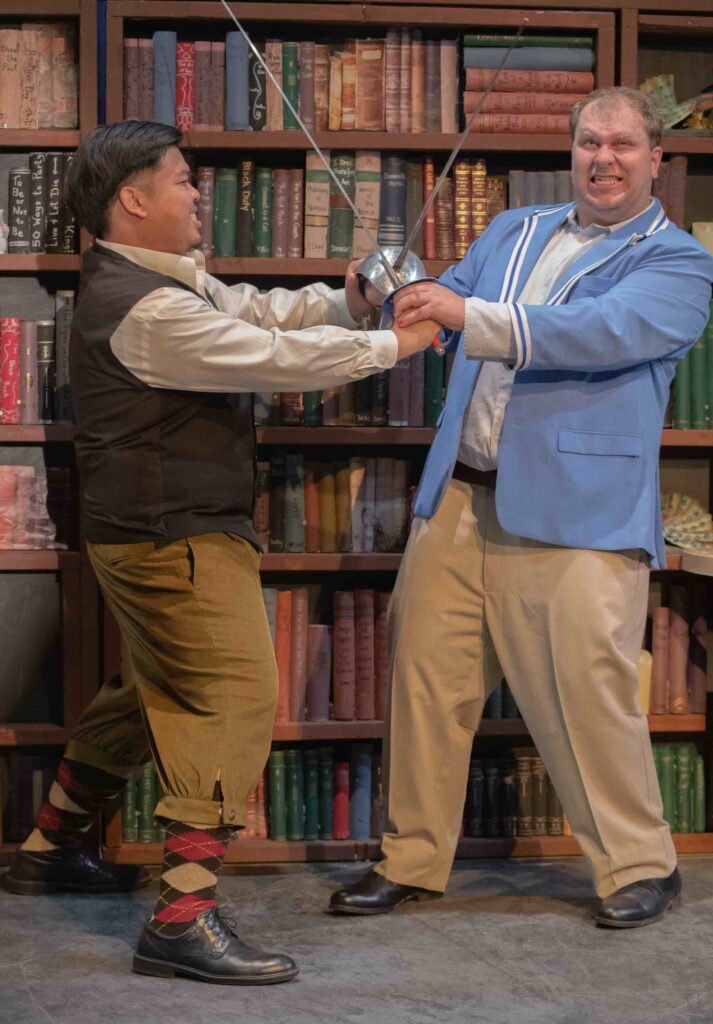
PHOTO: Dundas Little Theatre
This production is an enormous undertaking for DLT and, from what I saw, a great success. As the program notes read, “this production has been one of the most challenging, complicated, and enormously enjoyable shows I have ever had the opportunity to work on.” This challenge becomes more and more evident to the audience as the play unfolds and the mishaps start to multiply: “What looks like complete chaos onstage is, of course, anything but,” the notes continue. “Every misplaced prop, missed entrance, collapsing piece of scenery, badly timed interruption, and theatrical catastrophe has to happen at precisely the right moment.”
This is exactly the aspect of the production that I find so amazing and I think deserves the highest praise. A cast and crew must normally learn their roles, lines, marks, and cues to perfection. Now overlay that with a structure in which everything is (purposefully) going wrong and you have a cast and crew (not to mention set construction team), carrying out a most delicate balancing act.
“Comedy always depends upon timing, but this play takes that idea to an entirely different level,” the program states. “The actors have had to learn not only their lines and characters, but an extraordinary sequence of physical actions, reactions, entrances, exits, and disasters. A moment that appears spontaneous to an audience may have required hours of rehearsal to make it safe, repeatable, and, most importantly, funny.”
Indeed, the cast has to hold two realities in parallel and, I imagine, must constantly override some of their natural instincts. And, in the event that one of the things to “go wrong” goes wrong in a slightly unexpected way, they must quickly calculate what to do in response. Thankfully, the production is led (and performed) by a number of theatre creators who are extremely experienced and knowledgeable about their craft.
There’s just a moment or two when actions feel slightly slowed down (presumably to avoid actual injury), but the cast is skilled at carrying out their most complicated choreography in a way that feels natural and fluid to the audience. In addition, the set has been designed and constructed to “collapse” and be put back together, again and again. Quite a feat. Essentially, it's a multi-piece puzzle of engineering. Well done!
Chris Cracknell (Chris Bean/Inspector Carter) is a wonderful ringleader for the evening in his dual role as president of the Cornley Drama Society production/director and the detective who investigates the murder. His resonant voice, charisma, and aristocratic manner hold the audience’s attention. Johnny Thirakul (Thomas Colleymoore) does an excellent job as one of the major characters who confidently carries the through-line of the story. Trinity Ozimok (Florence Colleymoore) is memorable with her vampy, sequinned flair that puts one in mind of golden age Hollywood femme fatales. She’s at her best during the hilarious fight scenes with Elaine Hale (Annie the stage manager).
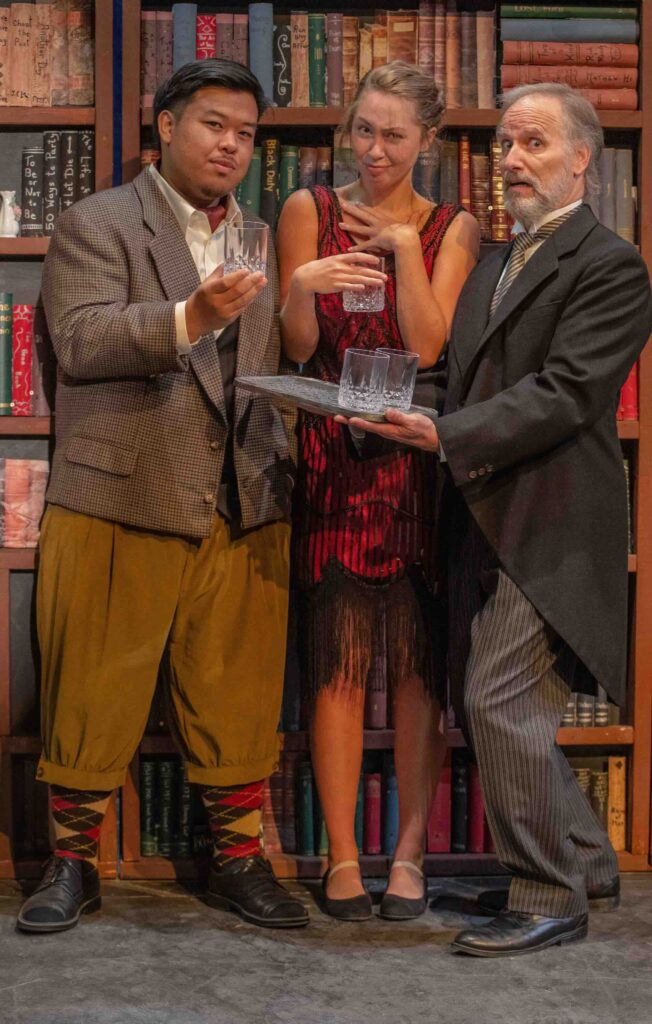
Hale is a delight as she evolves over the course of the play from valiant but harried stage manager to reluctant stand-in to a newly christened performer, unwilling to have another actress steal her lines. Her body language and facial expressions evoke sympathy and hilarity simultaneously. Michael Wilmot (Dennis/Perkins) is similarly skilled at letting his posture and eyes tell the story as the anxious and loyal manservant to the late Charles Haversham. His looks of fear and put-upon dread were perfectly suited to increasingly unhinged action taking place.
David Gibel (Cecil Haversham/Arthur the gardener) is fully committed to the comedy in his scenes and in getting the laugh. He is particularly funny and quick-witted when he breaks the fourth wall and engages the audience directly. Luis Arrojo (Trevor the lighting and sound technician) is also able to directly engage the audience and use some deadpan delivery to comedic effect. Andrew Finnigan opens the play as the (not dead) dead body of Charles Haversham, and his return to stage sees him land a multi-step, tumbling, (slow) action hero fall that brings him cheering applause in the second act.
As the chaos mounts, we see glimpses of “stage crew” Alicia Nunn and Ky Moruzi, looking hilariously like deer in the headlights as the folks we’re really NOT supposed to see if a play is going well. Everyone comes together very well to build this increasingly bizarre maelstrom of a murder mystery gone terribly wrong.
The Play That Goes Wrong is a wonderful choice of production in a time that continues to feel complicated, stressful, and out of control for many of us. The play invites us to laugh at the mishaps and recapture some of the similar joy we’ve found in physical comedy troupes or slapstick cartoons that leave us laughing until our stomachs hurt. The community appears to agree as the remaining performances are now subject to a wait list (details below).
NEED TO KNOW
Continues Nov.13, 14, 19, 20 and 21, 7:30 p.m.
and Nov. 15 and 22, 2 p.m. (Sunday matinee)
Dundas Little Theatre
Garstin Centre for the Arts
37 Market St. S., Dundas
Tickets: $27 regular, $22 seniors and full-time students
Please note: The remaining performances are now SOLD OUT. Join the wait list here
Audience advisory: gunshots, flashing lights, smoke machine
Run time: 2 hours with an additional 20 minute intermission