






REVIEW: Look Back in Anger is an earthquake of a play

Despite some strong performances, John Osborne’s shocking play about young male rage by Kitchen Sink Collective never really comes together.
When Look Back In Anger was first staged in the ’50s, it was a shocking revelation. An unrelenting realist screed set amidst a sea of polite drawing room farces, John Osborne’s play was an earthquake from which modern theatre is still reeling today.
Local company Kitchen Sink Collective has built a reputation on staging dramas set in claustrophobic rooms where the stakes are sky high. In tackling Osborne’s 70-year-old drama, the company is returning to the source of their namesake, staging what has been called the first “kitchen sink” drama. It’s a worthy effort but, despite strong performances, the production doesn’t hit the way it should.
Set amidst the bleak industrialism of post-war England, Look Back in Anger takes place entirely inside the cramped flat of working-class couple Jimmy and Allison. Sharing the space with mutual friend Cliff, their lives consist of domestic drudgery supported by Jimmy’s aimless work at a confection stall. In the meantime, the irascible Jimmy is in a near-constant state of criticism aimed at anyone and anything that earns his ire, mostly around class and society.
With tensions high, a violent incident raises the stakes between the trio and calls into question just how long Allison can survive her husband’s company. But when her friend Helena arrives for a brief stay, it proves the catalyst that detonates the unstable dynamic for every character, while revealing damaging secrets and lies.
To be clear, the production has strengths. Foremost is Gregory Waters as Jimmy. A challenging role demanding playfulness and fury, Jimmy is the focus of nearly every scene. Waters skillfully presents him as a man of pitched contradictions; he is chummy and charismatic, only to suddenly turn petulant and viscous. It makes for an unpredictable and thrilling experience as we follow him through the play’s narrative.
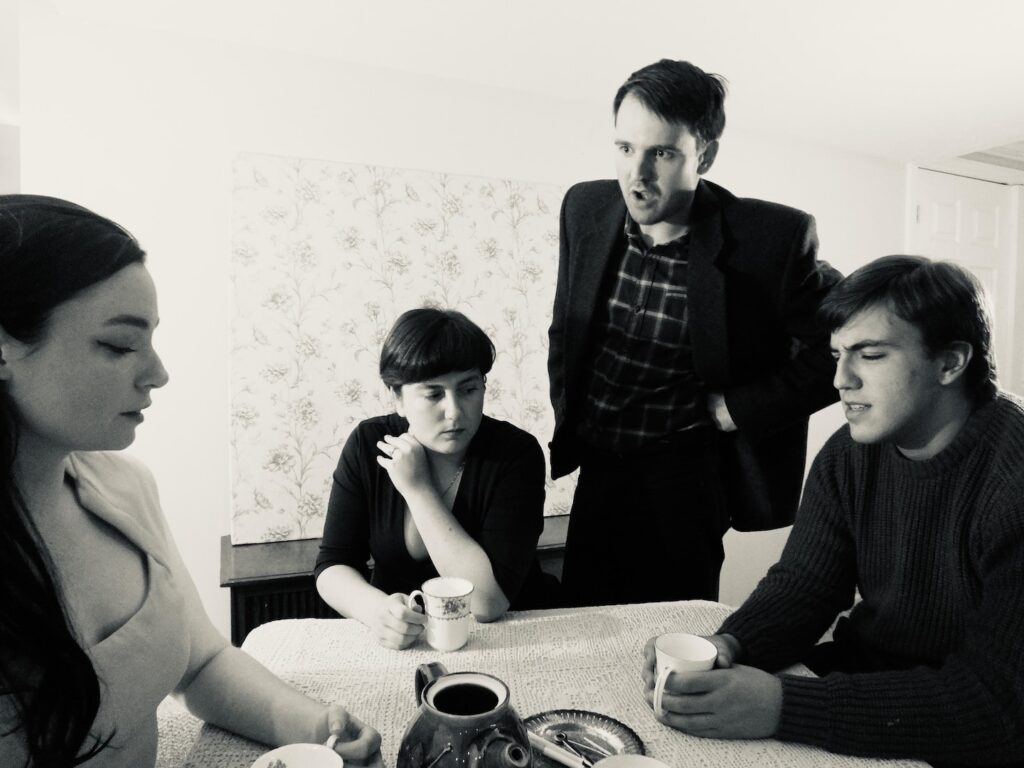
Nell Hayutin gives a restrained performance as long-suffering wife Allison. For much of the play, Allison must endure every painful invective aimed her way yet, thankfully, Hayutin plays her with unwavering restraint instead of outrage. It’s only at the climax, when Allison confesses her pain, that Hayutin lets loose a wave of anguish, and the effect is devastating.
Unfortunately, Waters and Hayutin's chemistry together lacks the passion that Jimmy and Allison’s relationship demands. While their mutual co-dependence is believable, their scenes lack the fiery urgency needed to show us what keeps them bound together in the first place.
The dynamic pops between Jimmy and Cliff, played by Adam Iachelli. From the top, both men have a lot of fun settling into the haphazard, bro-ey rhythm of their friendship. Though Jimmy is the alpha, Cliff pulls his strings, partly to keep his attention and partly to protect Allison. Iachelli also does good work with Hayutin, as their characters lean on the other to shelter from Jimmy.

Helena, played by Amy Ryan, brings both ambiguity and menace to the play, leaving us unsure whether she wants to protect Allison or replace her. Unfortunately, Ryan can't quite convey the more subtle and tender depths of her character. She holds her own well opposite Waters, but her quieter dynamic with Hayutin plays a little flat.
In a brief but memorable role, veteran actor Paul Rivers delivers sincerity and warmth as Alison’s father Colonel Redfern. With both a stiff upper lip and a sense of deep reflection, Redfern is everything Jimmy is not and Rivers masterfully conveys a realization that he’s failed as both a parent and a man in the modern age.
Carm Iachelli, who returns after directing the company’s acclaimed production of True West, has taken the basement stage of West Plains United Church and turned it into a cluttered, claustrophobic mess. Using both cramped furniture and shambled set dressing, the staging works well to box in and trap the characters. However, from a practical standpoint, it limits their movement and slows the pace down.
This may be why many crucial moments simply don’t land with the weight that they should. Too often, revelations of secrets or betrayals receive short shrift for the characters and the audience. It makes for a production that refuses to settle on sentiment. No doubt it would please Osborne, but it leaves audiences scrambling to sit with the story’s heavier beats.
Overall, Look Back In Anger is a competement production of a play that remains topical, an unflinching glimpse at how young people feel left behind. Yet, despite some strong work by the actors, the production never really gels and we are left wanting for the same kind of shock audiences felt on seeing the play for the very first time.

NEED TO KNOW
Look Back in Anger
The Kitchen Sink Collective
Oct. 1 - 4
West Plains United Church
549 Plains Rd. W., Burlington
Tickets here