





FOR THE LOVE OF HAMILTON
This regular feature highlights people from all walks of life who have embraced Hamilton as their new home.
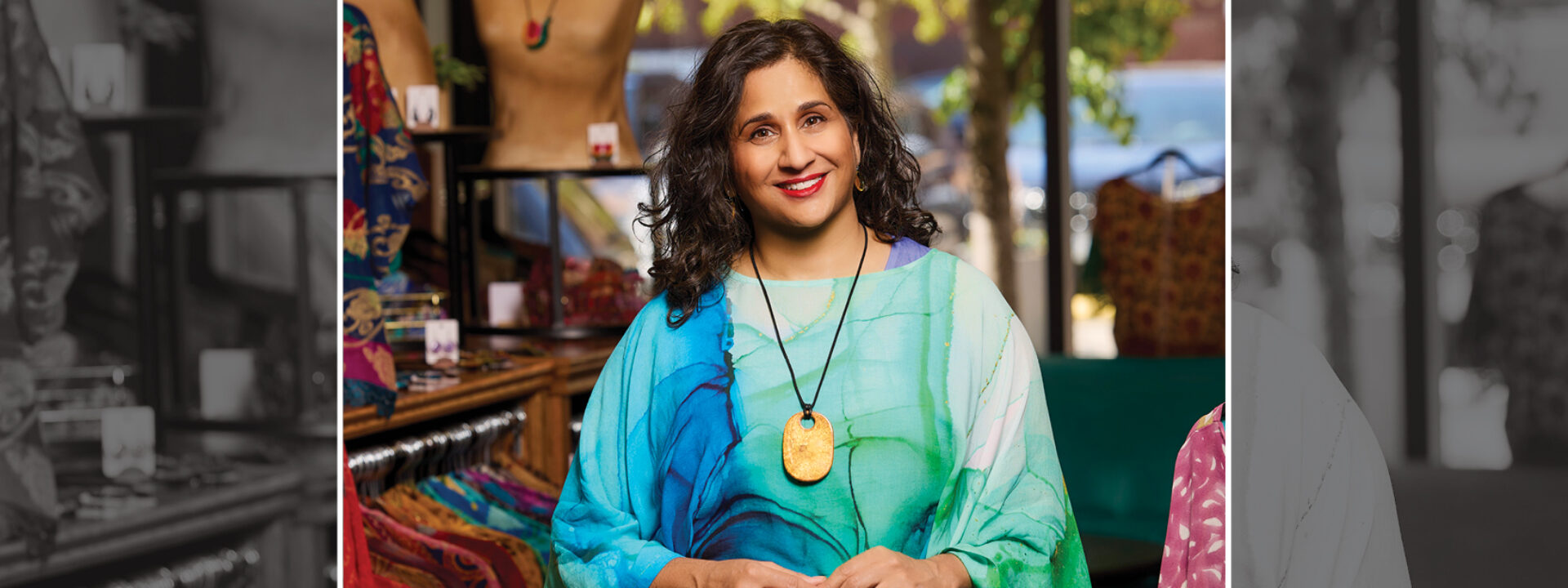
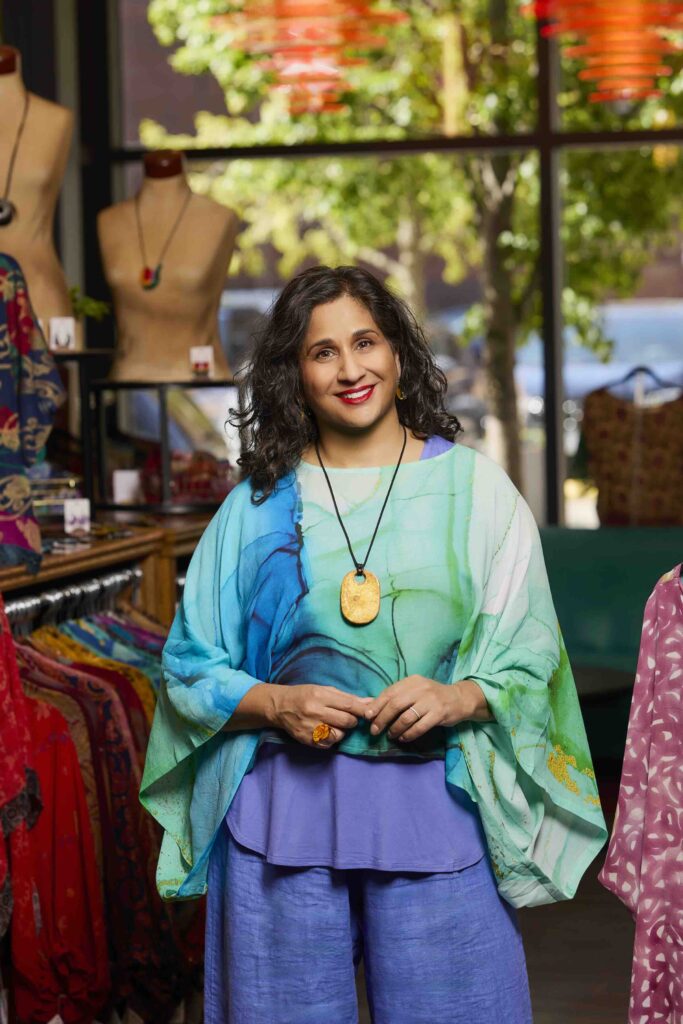
PRIYA MOHAN is the founder of sariKNOTsari, a Canadian fashion brand built around one-of-a-kind upcycled silk clothing, ethical production, and the belief that women deserve to feel both comfortable and fully themselves.Born in Ottawa and raised primarily in Brampton, Mohan spent 25 years as an educator and special education teacher before transitioning into entrepreneurship. Along the way, she attended law school, opened a vintage, and antique furniture business called Greystone Fine Furniture, helped create The Pale Blue Dot on James Street North in Hamilton, and eventually launched sariKNOTsari after years of travel between Canada and India developing early collections and production relationships.
What began as a small creative experiment quickly evolved into a nationally recognized sustainability-focused brand known for its size-inclusive silk garments, community-centred philosophy, and unconventional approach to fashion and aging.
Mohan often speaks about women reclaiming visibility as they age, the relationship between clothing and confidence, ethical consumerism, and how dressing slightly outside of expectation can become a powerful first step toward finding one’s voice. She lives in Burlington with her husband Gord, is the mother of three daughters, and remains deeply inspired by creativity, community, and the possibility of building businesses that genuinely make people’s lives better.
Tell us about your career before your store.
I went to law school but it wasn’t for me. I am too idealistic. So I went into teaching, and I thought, if I wanted to make the world a better place, the way to do it is to start getting younger people thinking. And so I did that for 25 years. And then towards the end of it, I opened a store. I had my three girls, but they were growing up and going to school full time. I love antiquing. I just love finding an old piece, and imagining the story behind it. I opened a store called Greystone Fine Furniture in Burlington and we were the first of our kind that put every single piece on the internet. But when baby boomers started to sell their homes, there were a lot of antiques on the market and their value went down.
How did you come to Hamilton?
So at that point I met with my team and I said, ‘We have some choices. We can either close down this business or do you guys want to do something else?’ One of my team members, Mary, suggested we extend the whole sustainable side of this business. And from that, we created the Pale Blue Dot. One of our team members, Kim Cruz, said the store should be on James Street North. I had never even heard of James Street, and she said, ‘Priya, you will love it. They have these art crawls, it's really up and coming, and it's like the place to be.’ So we checked out James Street North, and we've just been in this area ever since.
What are the roots of sariKNOTsari?
I took a family trip to India. My kids had never been. I hadn't been since I was 18. I fell in love with the fabrics again. I had been raised with these fabrics. I didn't buy a sari, I mean, I know I have nowhere to wear one. So I went online, and that's when I discovered that there was a whole market of vintage saris available, and I had no idea. So I started looking at these things, and I'm like, you know what, I want these fabrics in my life, but I am not going to wear a sari to Fortinos or to walk the dog. First of all, I’m not graceful enough, even though culturally I probably could. The chances of everything falling right off of me are so high that it just can't be done, but it did get me thinking, because I was working with this sustainable idea, the idea of what can we do, what choices can we make to help the planet moving forward, and at the same time my body really started changing.
I get to 42 years old, nothing fits. And I'm looking in my closet, and I see a stack of white linen pants. Now, nobody needs a stack, so I'm looking at them, I'm like, why do I have so many? Then I realize I've bought each one for one season, and then I haven't gotten rid of it. The next time that season came around, those ones didn't fit but they're such high quality, I can't really throw them out. What if they fit one day?
What inspired you to begin your business?
The problem is not me. The problem is that the people who make these clothes know my body's going to change. And they want it to happen. And I thought if I were to ever create my own clothing line, I would want fabrics that I love, that bring me joy and it's got to be able to adapt to my changing body, so that I get to decide when I'm done with my clothes. They don’t get to decide when they’re done with me.
So I was thinking about sustainability and creating my own clothing line with these pure silk saris that will fit everybody over time and are ethically made. The saris are still stunning. Each one represents an era.
What is your approach to business?
Someone asked once how do you create a business. The answer I gave was that you connect the dots, you just see all of these things that are, you know, floating around you, and you just bring them all together. So sariKNOTsari began in the basement of Pale Blue Dot in 2018. Eventually, we needed more space, so Mary and her family bought us out and sariKNOTsari moved to 231 James St. N. We were there for three years and then moved across the street to 228 James St. N. This year, we moved to 25 King William Street. We needed a bigger space and it’s right on the doorstep of James North.
What is your connection to Hamilton now?
I am a true Hamiltonian. I don't live here yet, but I anticipate living here one day. We just bought a triplex for my youngest daughter in a lovely neighbourhood by Gage Park. And I'm
thinking, why wouldn't somebody want to live here? You've got the water right there; you've got the escarpment right there. It's a nice neighbourhood. There's a bit of pretension in Burlington. It's not as bad as Oakville. Oakville is vocal pretension, Burlington is quiet about it.
I can't imagine ever moving my store. The people here in Hamilton, they are loyal, and they are happy that you're supporting their community and they will support you. And the artist culture in Hamilton is so strong.
How does your business support your goals of sustainability and empowering women?
I had heard speakers who were part of child labour, and one story stands out. This woman was saying how she was locked in a room with a pile of fabric. It sounds like something out of a Grimm's fairy tale. She said those fabrics are literally covered in her tears, because she had to just take those fabrics and churn out things every single day. I think her parents sold her off. She said there was somebody who came to the window and became her friend and taught her language, taught her how to write, and that's how she eventually broke free and became an advocate for children's rights. So I decided there is no way that I'm going to create something that takes advantage of people.
So it started with me coming up with my designs and working locally with a tailor who lives here in the Hamilton area. And we started with just one or two designs, and then eventually when I went to India on a second trip, I connected with a tailor just outside of Delhi and since then I've watched her kids grow up.
We also have a lady who finds our saris and we feel really good supporting these women. Our sourcer has four children and her husband died. It's generally a male-dominated industry. But if you are a woman of means in India, you know how to haggle, and you know how to get the best of the best, because you're not naively thinking that people will treat you right.
She berates (sellers) like their mother, and then they get her what she wants. So, we get the best of the best. The saris come in bundles of about 200 and we will go through thousands of them. She holds them up and we talk about the colours and the borders of the fabric and the quality of the silk, and the special embroidery techniques. And we decide what each will become. Every single piece is curated. There is no mass production.
Where did the name sariKNOTsari come from?
So it started off as a joke. I was talking about creating this brand, and that it would be clothes made out of old saris, but they're not really going to be saris anymore. Just like if you took jeans and turned them into a vest, it wouldn't be a vest. And Mary at Pale Blue Dot said, ‘It's like a sari, but not a sari.’ And I said, ‘Sari knot sari.’ And that's where it started. When we style our pieces, we put knots in the silk all the time, and it's part of the versatility that you can turn a tunic into a top, for example. So the name really just became symbolic of the versatility of the brand. These fabrics are vintage, and may have some flaws, because they've lived a life. And that's OK. So have I.
Where are the clothes produced?
So, everything gets made in India. It’s partially because of the cost of production in Canada, but also we work with really silky fabrics. They are so soft and slippery that you need experience with these very slippery fabrics. We have two master tailors, tailoring is a male job in India, so they do all the sewing, and you can actually see who's made which piece, because a tag tells you who made it. We also have some younger tailors who can handle some of the simpler pieces and a team of young women who finish the garments or mend the vintage fabrics. Our female head designer was able to buy a condo because of her work with us. So now her family is going to be set for life, for generations because they own something. Everything comes to the store here and we sell online in a virtual store, and ship from here. We also wholesale to other businesses.
How did your family come to Canada?
My grandfather was actually the first Gujarati to come to Ontario. He came here in the very early ’50s. He called my dad over when my dad was 18, and then, bit by bit, we got the rest of the family over from India. So, you know, we have people in our family who are fourth generation Canadian.
His family put my grandfather on a ship to Canada. He landed in New York, and then from New York there was a ship to Brockville in the Thousand Islands area. He immediately got recruited by RCA because he had an electronics background. My family was the first family to bring electricity into their village, so they were trained as electricians when electricity first started. So because he had that electrical training, he was hired by RCA, and he stayed there for 50 years and got a gold watch when he retired.
What does it take to be an entrepreneur?
Courage, grit, really hard work, a dream, because during those hard times you really need to believe in what you're doing. In terms of Hamilton, I have always said the reason that there are so many exciting businesses here in Hamilton is that it is a place where, if you have $1 and a dream, you can see your dream come to life, whereas in a lot of cities you can't. Hamilton's a great place to give it a try. You don't make a lot of money as a business owner. I tell my customers, prices are going up, but I promise you, I will never be able to buy a yacht. This is just the cost of doing business, unfortunately.
What is the greatest joy in your work?
The colours, the creativity, and honestly, the people of our customer base is one incredible woman after another. The customers who walk through the door are kind and happy and fun, and there is joy in watching them excited about their clothes. And my team is remarkable. We have Kim and myself and three young ladies.I'm watching them grow in front of my eyes, and they are so caring.
It can be a lot, having a business and the responsibilities of that. The mom in me always feels like I need to make sure my team is OK financially. It's my job to bring in the money to pay their lives, and I want my girls to have homes, to have cars, to have the things that they should have, and I need this business to be able to do that.
We have a lot of fun here. We actually film our meetings each Friday live where we pick our saris. We just do it because people love to watch, and they actually have a game where they're like, ‘Will Priya say yes to this one, or will Priya say no to that one.’ People will chime in and ask, ‘Why not that one?’ And I say that it’s the wrong yellow. It's so much fun, and I think that's why we have such a great community, both local and international. People here now have friends all over Canada. If you own the same sari fabric as someone else – we can only make three pieces out of each sari – so if you have the same sari fabric as someone else, that means out of the thousands you could choose from, you two were both attracted to the same fabric. So, they call each other sari sisters. It has become something so positive and inspiring. In B.C., there are these two ladies, Lori and Margot, who meet up for coffee at a garden centre once a month and they both dress up in their finest silks.
We're actually having a huge swap and sell with people from all over North America who are going to come and visit us in July. They will bring in their pieces and they can trade amongst themselves, because normally the swap and sell is done online on the Facebook group, but they all wanted to meet each other.
What is the biggest challenge?
The economy. We took a bit of a nosedive there when the tariffs on India happened but those are starting to unravel now. What we really lost was our U.S. clientele, because the tariffs were the punitive 50 per cent. But now we don't even know what it is. It's somewhere around 10, so we're absorbing a lot of that right now. Our American market was really booming, and then we had to pull back.
So definitely the hardest thing is trying to be a small business in this economy. People are wondering whether they can afford gas next week, right? So, are they going to spend $300 on a dress? But life is short and the world is crazy. Embrace the things that bring you joy.
Who inspires you?
I would say it's my kids. I want to make sure that I leave a decent planet for them, so I'm inspired to do my part. And then I'm also inspired by our customers. I just took this idea and I floated it out there and said this matters to me, and so many women were like this matters to me, too. So I feel like they reinforce this dream that I have, that I'm not standing alone, that together we can actually create something. It goes with my team as well. They're so capable they could get jobs anywhere, and they choose to stay with me.
What are your daughters doing?
My oldest, Nisha, is 30 and she’s a practising psychotherapist in Ottawa. My middle daughter, Henna, is 28 and she’s an associate at a law firm that does a lot of public law. She’s in Ottawa, too. My youngest is Mira and she works with us here. She was one of those kids who was in university when COVID hit, and the world was falling apart, and she's one of those 2000 babies where ever since she was born, something horrible has been happening. So she took a couple of years off to regroup, and now she's at Mohawk for human resources.
What neighbourhood do you live in in Burlington and what do you love about it?
I live in Tyandaga. I used to live in downtown Burlington. We've been in our new house for about three years. We downsized because the kids are all gone. And I love the trees and the fact that the neighbours all know each other, and the dogs all know each other. We have older people on the street who've been there since those houses were built in the ’70s, and then there are some that are newcomers with little babies. It feels very safe.
What is your favourite hangout in Hamilton or Burlington?
I have to be really honest with you, I don't have a lot of time to hang out. But I have aspirational places. One day, if I have time to hang out, I really want to hang out at Relay Coffee. There's that whole thing about working from a coffee shop, which you can do in a lot of places around here. I just love the thought of that.
What is your favourite meal when you eat out?
I went to Conversate across the street. I was shocked at how good it is. And the funny thing is, I don't even eat beef. My test is, if I had to kill it myself, could I? And I couldn’t kill a cow. But I loved the food at Conversate. I had an organic chicken that was delicious. The sides were unbelievable. The atmosphere was unbelievable. I will definitely be going back.
What Hamilton or Burlington arts or cultural events do you look forward to attending?
I love art crawl. Whenever I’m there, I can’t believe all of these people are there for free, like without any of that capitalist stuff going on. It’s real people sharing their real things. And now I'm looking forward to how that's going to extend into King William with the pedestrian zone.
What do you do in your spare time?
I asked my team what I do when I’m not working and they said nothing. But I do like to go to antique stores. I don’t shop, but I like to look and to remember. Just like our fabrics, the antiques have stories to tell. And I don't think that's something you get with regular clothes, so everything that you buy becomes a treasure.
What is Hamilton's best kept secret?
I would say the restaurants. People don't realize how good the food is. You think of Hamilton, you kind of think of steel, maybe a bit of chaos, but you don't think amazing food.
What does Hamilton need more of?
I want to say advertising. I think there's not enough marketing going out generally to the public about how great Hamilton is. If you look at the nature around Hamilton, the waterfalls, the little neighbourhoods, the waterfront, the trails, now the (TD) Coliseum. Hamilton needs a rebranding, and rebranding takes marketing.
What's the one thing that you brag about Hamilton to outsiders?
You don't meet pretentious snobby people, you meet salt of the earth, real people, who will speak to you honestly, and who love the artist community here. Nobody understands until they come here. So, I talk about that, and I talk about the food. You maybe need a tour guide the first time you come to Hamilton, so you don't end up in a place where you're like: Is all there is? You need someone to take you to the waterfalls, take you to the trails, take you to the Bayfront Park, take you to this street, and the kinds of restaurant offerings that are around in this area.