



Solo show shares stories from frontline shelters during the pandemic

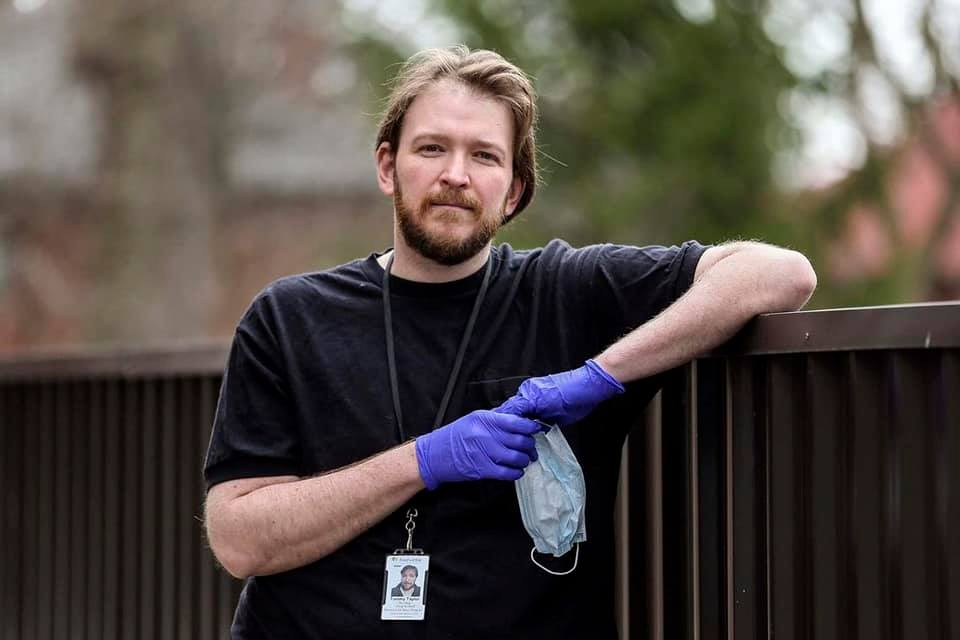
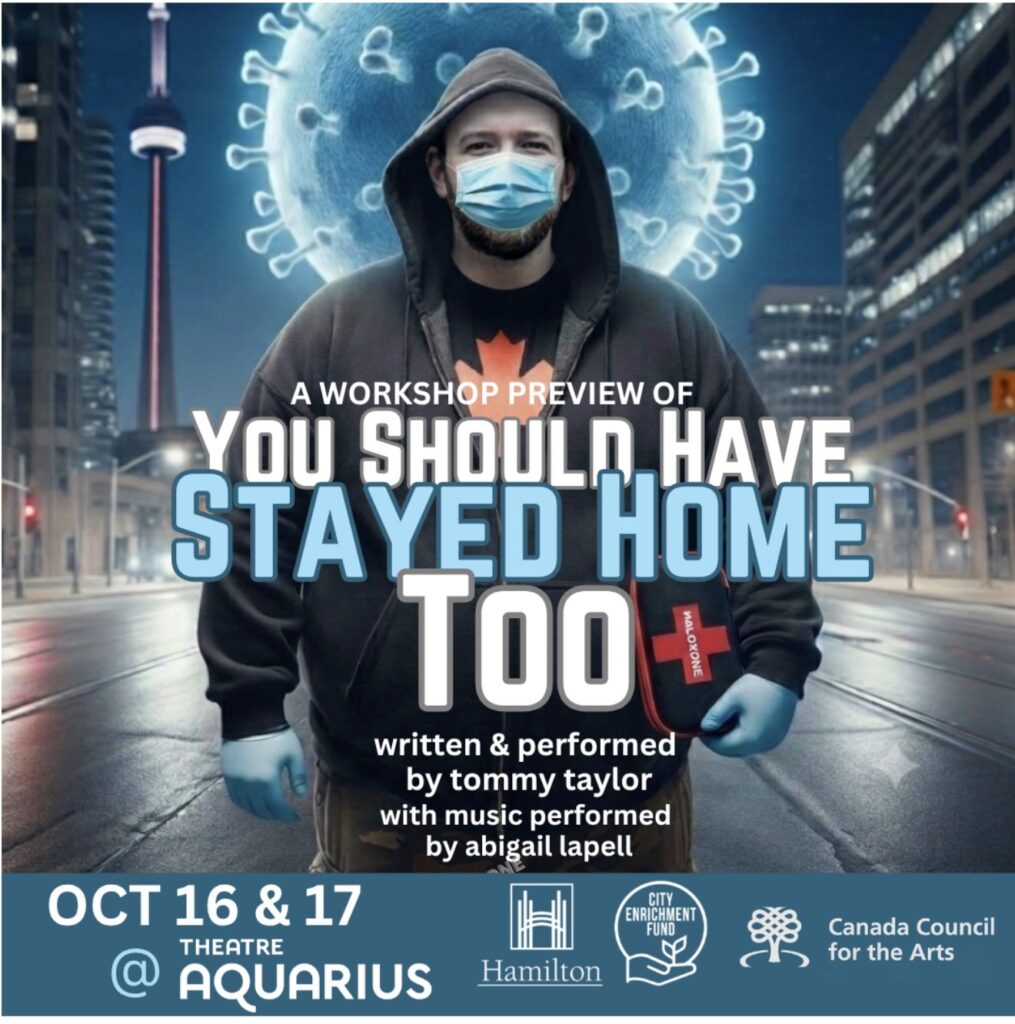
Hamilton playwright Tommy Taylor will debut You Should Have Stayed Home Too at Theatre Aquarius. The show drawn from his decade working in emergency shelters and overdose prevention sites features lost music from his late aunt, who was best friend, roommate and collaborator of Joni Mitchell.
A Hamilton playwright’s documentary solo performance drawing from his decade working overnight shifts in shelters and overdose prevention sites in Hamilton and Toronto, and the crisis that exploded during the pandemic will present a workshop presentation in Hamilton this week.
Tommy Taylor’s You Should Have Stayed Home Too also features the first‑ever live performance of lost 1960s recordings by his late aunt Vikky Taylor, who was Joni Mitchell’s best friend, collaborator, and roommate in Yorkville, and girlfriend of Neil Young.
Taylor says he felt compelled to tell the stories of people he met and tried to help, many of whom, he says, are no longer here to tell their own tales.
Taylor points out that his show comes as opioid‑related EMS calls have surged by 199 per cent in Hamilton since the closure of Ontario’s supervised consumption sites, and the number of people experiencing homelessness in Hamilton has risen by 131 per cent since 2020.
“There is some growth that we can do as a community to understand our brothers and sisters. The situation that we find ourselves in is very, very overwhelming and it's pervasive in every city. This has its origins but these are our fellow humans who are more like the rest of us than people can bring themselves to think,” Taylor told HAMILTON CITY Magazine.
In the shelter system, Taylor came across people who suddenly lost a job, gay teens who had to run away from home, and people fleeing sexual abuse. Some had development disabilities, acquired brain injuries, or physical disabilities and no support system.
“I worked with people who used to be lawyers. I worked with people who used to be doctors. I worked with a man who, several years before had knee surgery and was prescribed oxy(contin) and oxy patches and was never told anything about them. And the grasp that opioids can have on some of us. It doesn't have anything to do with willpower, it’s the absolute devastating chemistry of it.”
Rather than making progress, safe injection sites have been shut down and overdoses are soaring, says Taylor. Detox, rehab, and mental health services are vastly inadequate, he says.
“So rather than use science and medicine, we are just, again, increasing that emergency response budget. We spend so much money on it. I don't know, it's like it's more important to feel righteous and judgemental than to solve the problem, be compassionate, and save money.”
Shelters are not the answer and neither are prisons, says Taylor. Those with addictions who go to prison “come out more connected to crime and drugs than when they went in.”
It costs many times more to house someone in prison than in supportive housing, says Taylor.
“So it drives me a little bananas and I just thought maybe we could talk about it,” he says.
“I think there's the stories about the people I just want to share. Those stories hopefully can create an understanding of why I see it differently.”
The roots of this show go back to 2010 when Taylor was part of the largest mass arrest in Canadian history at G20 Summit in Toronto.
“I was on my way home and they rounded us all up and we all went into handcuffs onto the bus and I spent 24 hours in a cage in the detention centre. I just saw things that I thought I would never see,” Taylor says.
“That was a pretty awful experience for me, but just seeing what was happening to disabled people, Indigenous people, Black people inside the detention centre cages was just a real eye opener. Having been a theatre artist up until that point, I took that experience, turned it into a one-man show and toured it across Canada having conversations with people in cities from the Yukon to Ottawa about civil liberties and police brutality and the right to protest.”
That show was You Should Have Stayed Home and Taylor found catharsis in it. Later, the arrests of about 1,100 peaceful protesters, journalists, and bystanders were found to be unlawful and they won a $16.5 million class-action lawsuit against the Toronto Police Service. Taylor was a co-lead plaintiff in that lawsuit.
That experience convinced Taylor to go back to school to become a community worker. He spent 10 years working in homelessness services, including emergency shelters, drop-ins, and outreach to those living in encampments and on the street.
He was running services at the women’s 24-hour drop-in in downtown Toronto when the pandemic hit. Police and paramedics didn’t want to come into the shelter and the hospitals didn’t know how to serve the homeless.
“Everything really fell apart and it became clear when we had this order to stay at home, there was no plan for the people who didn't have a home. And things just got continually worse from there: not enough PPE, not enough directive, not enough space. We have to social distance. So already overcrowded and full shelters were pushing people out into encampments and encampments were booming, and people were losing their jobs or they were getting kicked out of non-regulated housing.”
Add to all of was a soaring drug crisis, with deadlier concoctions killing people at an alarming rate.
“I lost more people that I had worked with in the first five months of the pandemic than I did in the last five years combined. It was just really horrible and the losses just kept on piling up and it just turned into three years of really wild, unbelievable incidents showing how fragile our systems are.”
In 2022, Taylor took a job at the Hamilton Urban Core Community Health Centre as manager of community health programs. At the time, the centre was running the only safe injection site in town.
Taylor, who lives in the Gage Avenue and Main Street area, was disturbed to get letters in his mailbox about stopping safe injection sites, and seeing comments on neighbourhood Facebook groups that drug users should just be let to die.
“It was just really vile stuff, and it hit me in terms of people that I lost, the human stories. There's a reason we are where we are. So I'm hoping that I can tell the story of that time and tell the story of those people, the people that we lost, and stories that people didn't hear.”
When he started to think about telling this story, it reminded him of his late aunt Vikky Taylor. She was once a girlfriend to Neil Young and a roommate to Joni Mitchell. Vikky Taylor’s Yorkville apartment above folk concert venue The Night Owl became the centre of Toronto’s 1960s folk scene. Vikky and Mitchell played in a duo together and it was Vikky who dragged a reluctant Mitchell to auditions.
“She was just doing some really righteous counterculture music and just some really beautiful songs.”

Oct. 16 and 17.
You Should Have Stayed Home Too features music from Vikky Taylor’s lost recordings, believed to have come from a CBC radio show in the ’70s called Touch the Earth with Sylvia Tyson. For You Should Have Stayed Home Too, these songs are interpreted and performed by Abigail Lapell, a four-time Canadian folk music award winner and a JUNO nominee.
Taylor says he’s honoured to introduce his aunt’s “beautiful and thoughtful” music to audiences. It’s fitting to use her songs in his production because his aunt, who died in 2023, epitomized lending a helping hand.
“My aunt, you know, she always had a pot of stew on the stove feeding anyone who wanted to come in, anyone who needed a spot to sleep. So she's providing shelter and food to people 60 years ago in Toronto and there I was in the pandemic trying to do the same sort of thing,” he says.
Taylor first shared some of his pandemic stories at Theatre Aquarius’s Brave New Works festival in 2024.
“The room loved it. I had a 45 minute slot but the producers were in the room and they said, “Keep going. We want to hear it all. So they made my slot go longer and they have been really supportive of the project ever since.”
Following each show will be a conversation on housing, the opioid crisis, frontline work, and civic responsibility. Taylor also asks his audiences to provide feedback about the show.
“It can be heavy material. We try to make it accessible, and there is some unforeseen humour that comes from it as well. It really runs an emotional spectrum for something that sounds like it might exclusively be a downer or an outrager. There are some moments in there where the joy and laughter of being a human being comes through.”
After Aquarius, Taylor will take his show to Crow’s Theatre in Toronto from Oct. 22-24.
“I think this is a show, though, that can speak to what's happening in any city in Ontario right now. Like the trajectory from the pandemic has been the same for all of us and we can all build back better,” says Taylor.
Crow’s artistic director Chris Abraham called Taylor’s show "gripping, deeply moving, and genuinely a call to action.”
Taylor, winner of a creator award from the City of Hamilton’s Hamilton Arts Awards this year, is now enrolled in the master’s of disaster and emergency management program at York University.
He wants to play a role in future emergency prevention, response, and recovery.
The show’s timing is not accidental, says Taylor. He hopes voters will reflect on its message during the upcoming municipal election.
“I'm hoping people can think about what they see in the show, what they feel about this show, and think about it as they head into the voting booth. Who is talking about moving us forward and who is talking about moving us backwards?”
NEED TO KNOW
You Should Have Stayed Home Too
Workshop presentation
Oct. 16 and 17, 7:30 p.m.
Written and performed by Tommy Taylor
Theatre Aquarius Studio
190 King William St, Hamilton
Dramaturgy by Karen Ancheta and Anand Rajaram.
Musical creation by Abigail Lapell
Each show followed by a post‑show conversation on housing, the opioid crisis, frontline work, and civic responsibility.
Tickets here